 En

trusted Decorative Panels enterprise
Decorative perforated panels sit at the intersection of structure and surface. On a building facade, a perforated metal facade controls solar gain, screens mechanical equipment, and gives the elevation a texture that solid cladding cannot achieve. Inside a lobby or an open office, a decorative perforated panel divides space without blocking light or airflow, and the pattern itself becomes part of the interior language. The functional side matters just as much: hole diameter and open area (the ratio of hole area to panel area) determine how much light passes, how much air moves, and how the panel performs against wind and rain. Because every project asks for a different balance of these variables, the supplier's ability to punch, cut, bend, and finish to a drawing matters more than any catalog of standard sizes. Hengai Metal is a perforated metal panel factory with its own production line, serving overseas buyers, design teams, and contractors who need decorative perforated panels made to specification and shipped as finished goods.
Product Range: What a Perforated Panel Factory Actually Makes
The core product is the metal perforated panel itself. Raw coil or sheet goes in, and a controlled pattern of holes comes out, with the pattern, hole size, and spacing set by the customer's drawing. Within that category, Hengai Metal produces several product types that buyers typically source separately:
Flat perforated metal panels for cladding, ceilings, and general screeningDecorative perforated panels with图案化排布, meaning pattern-based layouts such as gradient, staggered, and mixed-hole arrangements
Perforated aluminum panels for facades and soffits, where weight reduction supports the curtain wall design
Punched mesh sheets used for ventilation, guards, and industrial screening
Hole shapes available include round, square, slotted (elongated), hexagonal, and custom special shapes. Each shape changes both the look and the mechanical behavior of the panel. Round holes distribute stress evenly and are the most common choice for facades. Slots and elongated holes open up more area at a given pitch and are useful where airflow matters. Hexagonal and custom patterns are usually specified for visual effect, and they require a dedicated punching tool or a laser path, which is where a factory with in-house cutting equipment makes a difference.
Typical specification ranges depend on material and application, but in general terms:
Sheet thickness: commonly from around 0.5 mm up to several millimeters depending on structural roleHole diameter: from small perforations in the 1–2 mm range up to larger openings of 10 mm and beyond
Open area: adjusted through hole size and pitch, typically chosen to meet a lighting, ventilation, or visual target
Panel size: produced to the drawing, with panel dimensions and joint layout agreed during the design stage
These figures are indicative only. Final values are confirmed against the project drawing, because a facade panel and an interior screen rarely share the same constraints.
Materials and Surface Finishes
Material selection drives cost, weight, corrosion resistance, and how the panel will look after years of exposure. Hengai Metal works with three main families.
Stainless steel. Grades 304, 316L, and 201 are all available. Grade 304 covers most architectural and interior uses. Grade 316L is the choice for coastal sites, high-humidity interiors, and applications where chloride exposure is a concern. Grade 201 is a lower-cost option suited to interior and dry environments. Stainless steel can be supplied with a brushed or mirror finish, and it holds up well without additional coating when the environment allows.
Aluminum. Alloy series 1xxx and 5xxx are the standard choices for perforated aluminum panels. The 1xxx series offers good formability and conductivity, while the 5xxx series, particularly the magnesium-alloyed grades, provides higher strength and better performance in Marine and exterior conditions. Aluminum is lighter than steel, which reduces structural load on facades and ceiling grids, and it takes powder coating and fluorocarbon coating well.
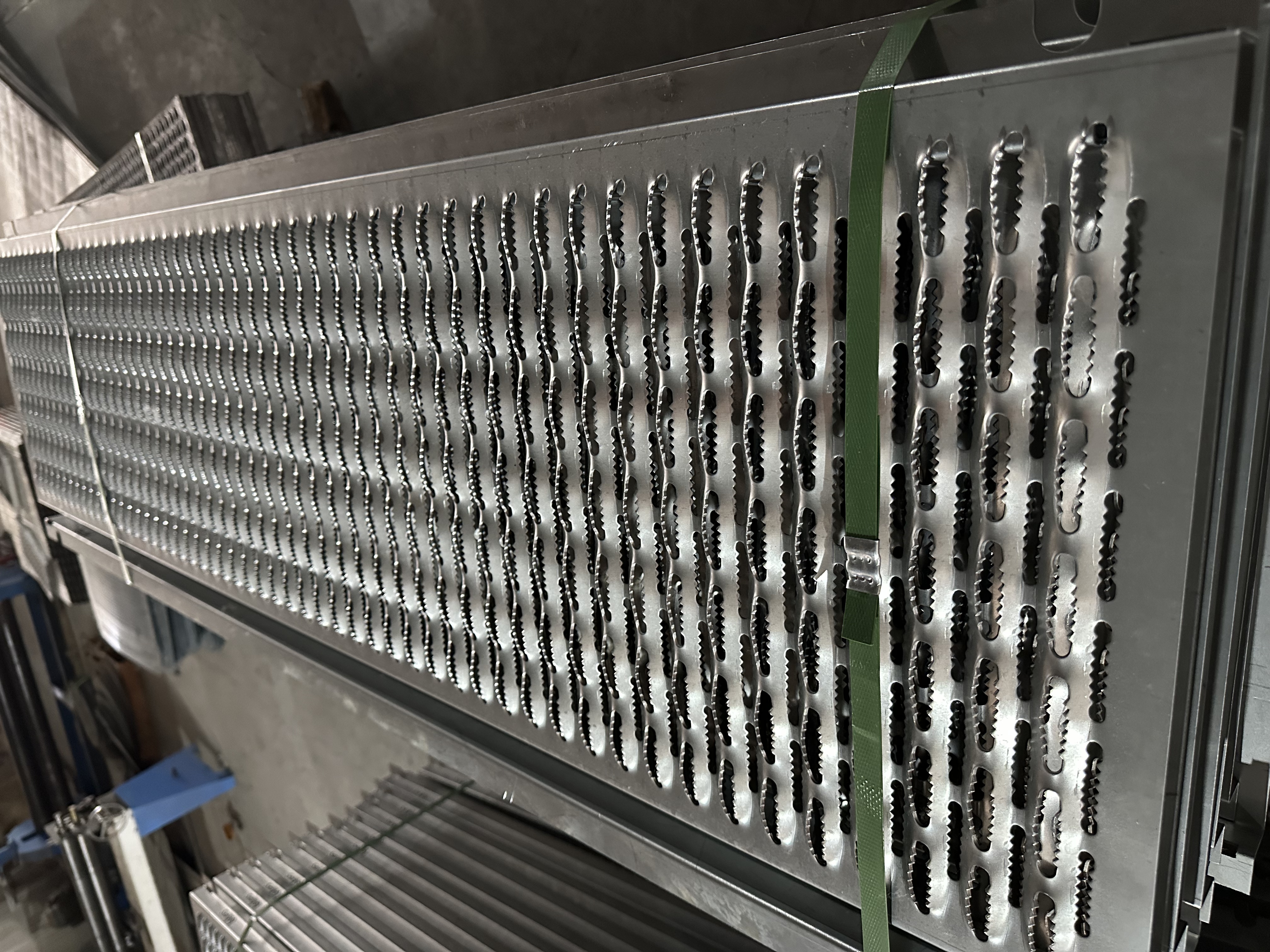
Galvanized steel. A cost-effective option for industrial screening, equipment guards, and applications where a zinc coating plus paint provides adequate protection.
Surface treatment determines whether a panel belongs indoors or outdoors. The table below summarizes the common pairings.
| Material | Surface Finish | Typical Environment |
|---|---|---|
| Stainless steel 304 / 316L | Brushed, mirror, passivated | Interior and exterior; 316L for coastal or humid sites |
| Aluminum 1xxx / 5xxx | Powder coating (polyester) | Interior and sheltered exterior |
| Aluminum 1xxx / 5xxx | Fluorocarbon coating (PVDF) | Exterior facades and sunshades requiring color and weather resistance |
| Aluminum | Anodizing | Interior and exterior where a metallic finish is wanted |
| Galvanized steel | Powder coating over zinc | Industrial and equipment protection |
Powder coating gives a wide color range and a durable film for interior and moderate exterior use. Fluorocarbon coating, usually referred to as PVDF, is the specification most often requested for perforated metal facades because it holds color and gloss under UV and weather exposure. Anodizing builds an oxide layer into the aluminum itself, which suits brushed and metallic looks. For stainless steel, brushing and mirror polishing are mechanical finishes applied in-house, and passivation can follow fabrication to clean the surface after welding.
Inside the Production Line
Understanding the sequence helps you judge whether a factory can hold the tolerances your drawing calls for. At Hengai Metal, production runs through a fixed order of operations, all under one roof.
1. Material preparation. Sheet or coil is checked for thickness, flatness, and surface condition before it enters the line. Material certificates are retained for traceability.
2. Punching and cutting. CNC punching handles repeatable hole patterns at production speed, using tooling matched to the hole shape. Laser cutting takes over for custom patterns, tight tolerances, and shapes that would require special tooling. The choice between the two is a cost decision as much as a technical one: standard round-hole patterns usually run more economically on the punch, while one-off or complex layouts favor the laser.
3. Bending and forming. Press brakes form return edges, stiffening flanges, and connection details. Bending after punching matters for facade panels, because the folded edges give the panel rigidity and provide the fixing surface for the subframe.
4. Welding. Where panels require frames, corner joints, or assembled units, welding is completed in-house. Welds are dressed and cleaned so the finish coat or brushed surface reads consistently across the panel.
5. Surface treatment. Powder coating, fluorocarbon coating, and anodizing are applied according to the specification. Pre-treatment before coating removes oil and oxide so the film adheres properly.
6. Inspection. Before packing, panels are checked for dimensions, hole pattern accuracy, flatness, and appearance. Where the order calls for it, third-party inspection can be arranged. Records are kept against the order so that any question after delivery can be traced back to the production batch.
Because punching, cutting, bending, welding, and finishing all happen in the same facility, there is no handoff between workshops. That reduces the risk of a panel being damaged or losing its dimensional reference between processes, and it keeps the schedule under one production plan.
Custom Work and Design Coordination
Most decorative perforated panel projects start with a drawing or a sample, not a stock item. Hengai Metal works from customer drawings and physical samples, and can produce trial panels before a production run so the pattern, hole size, and finish can be reviewed in hand.
Three technical points are worth settling early.
Open area and hole size. Open area is set by the ratio of hole diameter to pitch. A larger hole at the same pitch raises open area and light transmission but reduces the solid material between holes, which affects strength and how the panel reads from a distance. For facades, the target is often a balance between solar control and visual openness; for interior screens, it is usually about sightlines and privacy. The factory can calculate open area from your proposed pattern and suggest adjustments.
Panel size and joint layout. Panel dimensions should follow the module of the supporting frame and the available sheet size, so that joints fall on structural lines rather than cutting through the pattern. Getting this right at the drawing stage avoids awkward site cuts and keeps the pattern continuous across panels.
Sample approval. A sample panel确认流程 lets you check hole quality, edge finish, color, and flatness before批量生产. Once the sample is signed off, it becomes the reference for the production run.
This is the practical meaning of custom perforated panel supply: the factory adjusts tooling, program, and finish to your drawing, and you approve a physical sample before volume production begins.
Where Perforated Panels Are Used
The applications below reflect the range of projects Hengai Metal supplies, and each one places different demands on the panel.
Building facades and sunshades. A perforated metal facade acts as a second skin over glazing or solid wall. The open area controls how much sun reaches the building, while the pattern gives the elevation depth and shadow. Panels are usually folded and mounted on a subframe, with the joint layout designed to follow the building module.
Ceilings. Perforated ceiling panels combine acoustic backing with ventilation paths for plenum spaces. Aluminum is common here because of its weight, and powder coating provides the color match to interior finishes.
Interior partitions and screens. Decorative perforated panels separate zones in offices, lobbies, and retail spaces without closing them off. Slotted and custom patterns are frequently chosen for these screens, and stainless steel with a brushed finish suits high-traffic interiors.
Railings and balustrade infill. Perforated infill panels provide privacy and wind screening on balconies and terraces while keeping a light visual weight. Edge folding and fixing details are worked out with the railing fabricator.
Signage and decorative components. Smaller perforated elements appear in signage, screen walls, and feature cladding where the pattern carries the design intent.
Ventilation and equipment protection. Punched mesh guards, ventilation covers, and machine protection panels use the same punching and forming capability, often in galvanized or stainless steel where durability matters.
Export Packing and Delivery
Overseas buyers need panels to arrive flat, undamaged, and correctly documented. Hengai Metal packs panels for export with surface protection and edge protection, and loads orders into 40HQ containers, which is the standard shipping unit for panel volumes. For large facade orders, panels are packed in sequence so that installation can follow the packing list on site.
Documentation is prepared per order. Depending on what the buyer requires, the shipment can include a packing list, material certificates, and inspection records. Additional documents are handled according to the order terms. Delivery timing is confirmed after order quantity and process requirements are reviewed, since coating, welding, and custom tooling each affect the production schedule.
What to Include in Your Inquiry
A complete inquiry shortens the path from drawing to quotation. When you contact Hengai Metal, the following details help the team respond with a firm technical proposal:
Material (for example, stainless steel 304, aluminum 5xxx, or galvanized steel)Sheet thickness
Hole shape and hole diameter
Open area target, or the hole pitch if already fixed
Panel size and joint layout, or a drawing showing both
Surface finish (powder coating color, PVDF, anodizing, brushed, or mirror)
Quantity, including any trial order volume
Destination port
If a drawing or physical sample exists, send it along. A sample removes ambiguity about pattern and finish faster than any written description.

Send Your Drawing for a Quote
Hengai Metal produces decorative perforated panels and perforated metal panels on its own line, from punching and laser cutting through bending, welding, and surface finishing. If you have a facade, ceiling, screen, or equipment guard project in development, send the drawing or a sample requirement with the details above. The team will review the pattern, confirm material and finish options, and quote against your specification. Trial panels can be arranged before volume production so you can approve the result in hand.