 En

Decorative Panels which ranking is best
Perforated metal is rarely the first thing a visitor notices in a finished building, yet it shapes how a space looks, sounds, and ventilates. A decorative perforated panel can soften a harsh facade, hide mechanical equipment without sealing it off, or turn a plain ceiling into a field of light and shadow. The panel itself is simple: a sheet of metal with holes punched in a controlled pattern. What separates a good outcome from a problem is how those holes are specified, how the sheet is formed, and who makes it.
Hengai Metal is a metal perforated panel manufacturer with its own production lines. The company punches, cuts, bends, welds, and finishes perforated sheet in-house, and supplies custom panels to overseas buyers, design teams, and contractors. This article explains what the factory produces, how the work is done, and what you should send when you request a quotation.
Product Range: From Standard Sheet to Custom Perforated Panel
Hengai Metal's core product is perforated metal panel stock, produced on CNC punching and laser cutting equipment. Around that core, the factory builds decorative perforated panel and perforated metal facade components to drawing, plus a range of formed and fabricated parts.
Hole patterns are the first decision on most projects, and the factory works with the common families as well as custom geometry:
Round holes — the most economical pattern, available across a wide spread of diameters and pitches.Square and rectangular holes — often chosen for a more architectural, grid-based look.
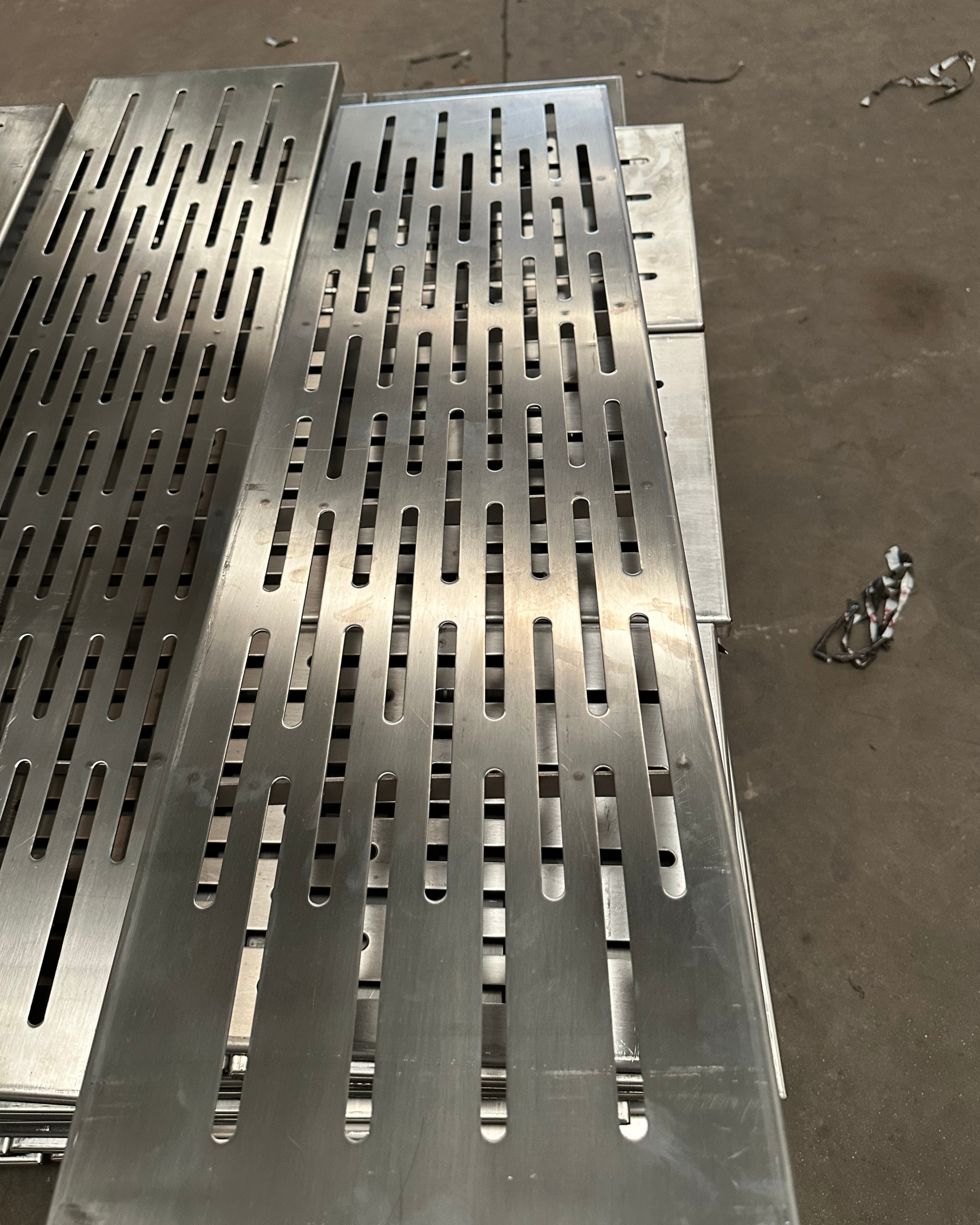
Slotted and elongated holes (long-round or louver-style) — useful where you want directional screening, better airflow, or a linear visual rhythm.
Hexagonal holes — a tighter open area for a given pitch, with a honeycomb appearance.
Custom shapes and pattern layouts — logo cut-outs, graduated patterns, mixed-aperture designs, and artwork-driven arrangements produced from a drawing.
Panels can be supplied as flat sheet or as formed components: bent edge returns, welded frames, fabricated louver assemblies, and perforated enclosures. The factory also produces perforated filter baskets and cylinders, protective guards, and acoustic panels, which combine punching, bending, and welding in a single part.
Typical stock and production ranges vary with material and tooling, so most figures are best treated as indicative until a drawing is confirmed. As a general guide, sheet thickness commonly falls between roughly 0.5 mm and 6 mm depending on the alloy and the hole pattern, hole diameters from about 1 mm upward for standard punching, and panel sizes up to the handling limits of the punching and cutting equipment. Open area (the ratio of hole area to total panel area) is calculated from hole size and pitch, and can be adjusted across a wide band to balance appearance, light transmission, and airflow. Tell the factory the performance you need and the team will propose a hole-and-pitch combination that meets it.
Materials and Surface Finishes
Material choice drives corrosion resistance, weight, and cost, so it should follow the environment rather than precede it. Hengai Metal works with three main families:
Stainless steel — grades 304, 316L, and 201. Grade 304 suits most architectural and interior applications. Grade 316L adds molybdenum for better performance in coastal, marine, and chloride-rich settings. Grade 201 is a lower-cost austenitic option often used indoors or in dry, protected conditions where full 304 performance is not required.
Aluminum — 1xxx series and 5xxx series sheet. Aluminum keeps weight down, which matters on facades and ceilings where substructure loads are a design constraint. The 5xxx series (magnesium-alloyed) offers higher strength and is commonly chosen for exterior perforated metal facade work; 1xxx series is often used for interior decorative panels and formed parts.
Galvanized steel — a cost-effective choice for industrial guards, screens, and ventilated enclosures where a painted or zinc-protected finish is acceptable.
Surface treatment determines how the panel ages and how it reads visually. The options below are the ones most often specified:
Powder coating — a cured polymer finish in a wide color range, well suited to interior feature panels, ceilings, and protected exterior use.PVDF (fluorocarbon) coating — a resin coating chosen for exterior facades and sunshades where color and gloss retention under UV exposure matter. Typical specifications are subject to the coating system and the project's exposure conditions.
Anodizing — an electrochemical oxide finish on aluminum, giving a metallic appearance and good wear resistance; common on interior and protected exterior aluminum panels.
Brushed and mirror finishes — mechanical surface treatments on stainless steel, used where the metal itself is the design feature: lift lobbies, feature walls, signage backs, and screen partitions.
| Material | Typical Finish | Suitable Environment |
|---|---|---|
| Stainless steel 304 | Brushed, mirror, powder coat | Interior and general exterior |
| Stainless steel 316L | Brushed, mirror, passivated | Coastal, marine, high-chloride |
| Stainless steel 201 | Brushed, powder coat | Interior, dry protected areas |
| Aluminum 5xxx | PVDF, powder coat, anodized | Exterior facades, sunshades |
| Aluminum 1xxx | Anodized, powder coat, mill finish | Interior decorative panels |
| Galvanized steel | Powder coat, mill finish | Industrial guards, screens, vents |
Finish selection should be confirmed against the actual exposure: an interior ceiling and a coastal rainscreen rarely call for the same specification. The factory will recommend a combination once the application and location are known.
How the Panels Are Made
Understanding the production route helps you read a quotation and anticipate where tolerances matter. At Hengai Metal, the sequence runs through the factory rather than between subcontractors.
1. Drawing review and programming. The engineering team checks your drawing or sample, confirms hole size, pitch, open area, panel size, and hole-to-edge margins, then programs the punching or cutting equipment. Ambiguities are raised at this stage rather than after production starts.
2. CNC punching. Turret punching produces the hole pattern at speed, using tooling matched to the hole shape. Round, square, slotted, and hexagonal holes are punched with standard or custom tooling; very large or irregular apertures may move to laser cutting instead.
3. Laser cutting. Used for custom outlines, mixed hole sizes, fine detail, and patterns that would be impractical to punch. Laser cutting also handles the outer profile and cut-outs for fittings, which reduces secondary operations later.
4. Bending and forming. Press brakes form edge returns, stiffening flanges, and connection details. Forming is where panel flatness and hole distortion are controlled, so bend lines are planned around the hole pattern rather than through it where possible.
5. Welding and assembly. Frames, reinforcing members, and fabricated parts are welded and dressed. For perforated components such as guards and baskets, welding is planned to limit heat distortion across the perforated field.
6. Surface treatment. Panels are cleaned and finished by powder coating, PVDF coating, anodizing, brushing, or another agreed process. Coating is applied after forming so that cut edges and bends are covered.
7. Inspection. Before packing, panels are checked for hole size and pattern alignment, overall dimensions, flatness, burr removal, coating appearance, and weld quality where applicable. Records can be provided with the shipment, and third-party inspection can be arranged at the buyer's request.
Because every step happens under one roof, a question about a bent panel or a coating defect can be traced back to the specific operation that produced it. That is the practical value of in-house production: fewer handoffs between suppliers, and one point of accountability from raw sheet to packed crate.
Custom Work and Engineering Support
Most projects do not buy a catalogue item. They buy a panel that fits a specific opening, matches an adjacent material, and meets a structural and visual intent. Hengai Metal's custom perforated panel service is built around that reality.
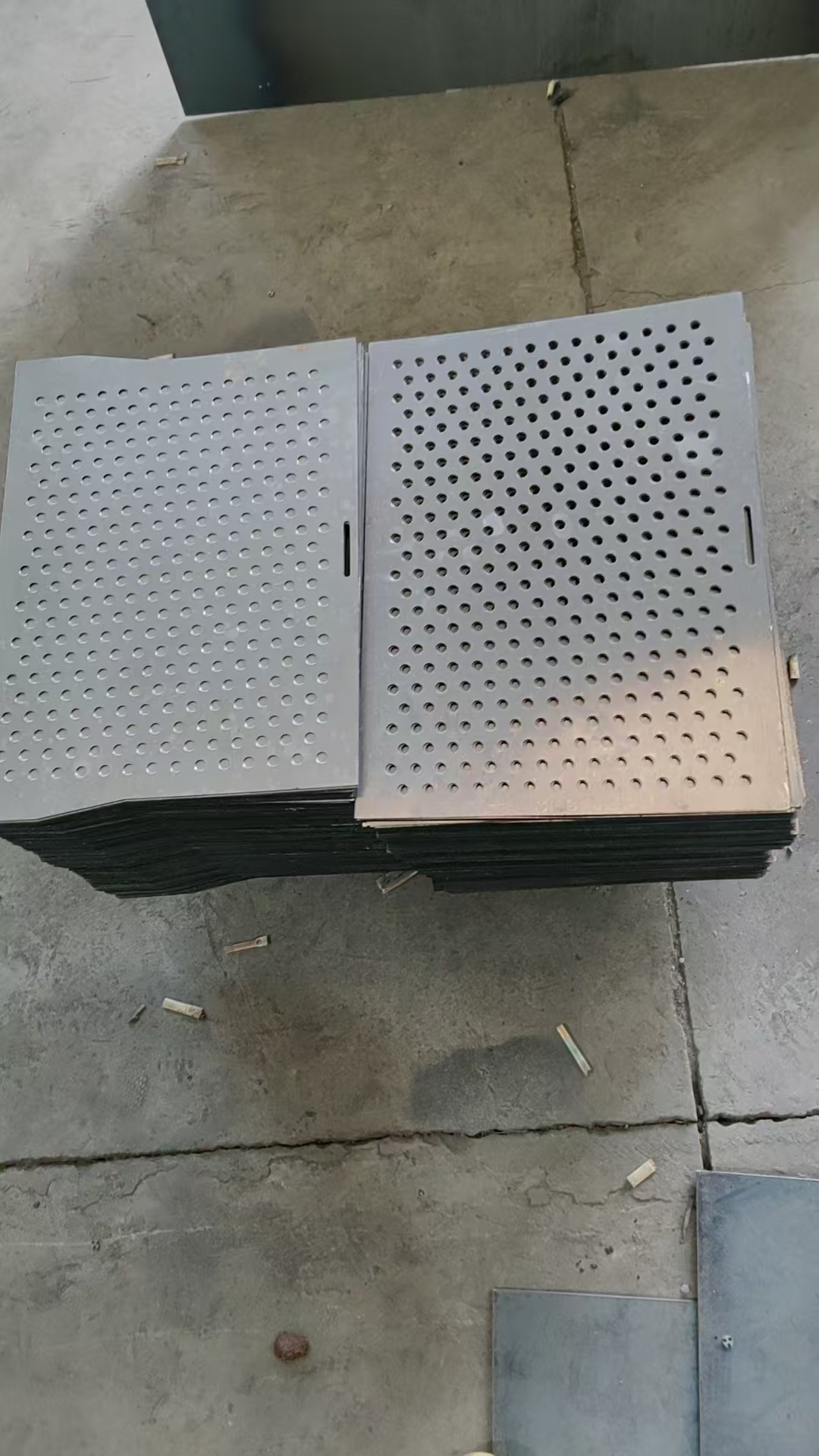
Working from drawings or samples. Send a dimensioned drawing, a DXF or DWG file, or a physical sample. The factory can produce tooling for non-standard hole shapes and will advise if a proposed pattern needs adjustment for manufacturability.
Open area and hole sizing. Open area affects airflow, light, acoustic behavior, and visual density. As a rule of thumb, a smaller hole at a tighter pitch reads as a finer, more solid surface; a larger hole at a wider pitch reads as more open. The engineering team can calculate open area for a proposed pattern and suggest alternatives if the target is not achievable with the chosen hole shape and thickness.
Panel size and joint layout. Panel modules should be set against the actual substrate, frame spacing, and expansion allowances. The factory will review your layout and flag where a joint falls awkwardly against the hole pattern, so that seams read as intentional rather than accidental.
Sample approval. Production typically begins after a sample is approved. The sample confirms hole size, pattern alignment, finish color and gloss, and edge treatment. Approving a physical sample before batch production is the most reliable way to avoid a mismatch on site.
OEM and ODM cooperation. The factory supports OEM and ODM arrangements and long-term supply agreements, and can hold agreed specifications for repeat orders. Small trial batches are accepted as well as larger production runs, with scheduling set according to order quantity and process requirements.
Where These Panels Are Used
Perforated metal earns its place in a project when a surface needs to do two things at once: look deliberate and perform a function. The applications below cover most of what Hengai Metal supplies.
Building facades and sunshades. A perforated metal facade provides solar screening, reduces glare, and gives a building a textured skin that changes with the light. Aluminum 5xxx with a PVDF finish is a common specification for exterior work, with panel modules set out to follow the structural grid. Perforated sunshade blades and louver screens use the same material and are often supplied as formed components.
Ceilings. Perforated ceiling panels combine a clean visual field with acoustic and ventilation function. Aluminum panels keep weight down, and the hole pattern can be aligned with lighting layouts and service outlets. Interior ceilings are usually powder coated or anodized.
Interior partitions and screens. Decorative perforated panel work in partitions gives separation without closing off light or sightlines. Brushed or mirror stainless steel is often chosen for feature screens in lobbies and reception areas, while powder-coated aluminum suits larger runs of office partitioning.
Railings and balustrades. Perforated infill panels provide a solid-looking barrier with controlled transparency, and can be formed and framed as complete balustrade sections. Stainless steel is common where durability and a metallic finish are wanted.
Signage and decorative elements. Custom hole patterns can carry logos, letterforms, or graduated graphic effects, produced by punching or laser cutting. These panels are frequently backlit, so the pattern is designed around light transmission as well as appearance.
Ventilation and equipment protection. Perforated guards, machine covers, and ventilated enclosures protect moving parts and allow airflow. Galvanized steel and stainless steel are both used here, with open area set to meet the airflow requirement. Perforated filter baskets and cylinders extend the same logic to filtration and separation duties.
Export Packing and Delivery
Panels are easily damaged in transit if packing is treated as an afterthought. Hengai Metal packs for export with protection against abrasion, edge damage, and moisture during sea freight. Finished panels are typically separated with interleaving material, edge-protected, and crated or palletized according to size and finish; coated and brushed surfaces receive particular attention because surface marks are difficult to remedy on site.
The factory has experience shipping full 40HQ container loads and can plan panel modules and crate sizes around container dimensions to make efficient use of space. For mixed orders, flat sheet, formed parts, and fabricated components can be consolidated into a single shipment where the schedule allows.
Shipping documents are prepared according to the order: packing list, material certificates, and inspection records can be provided on request, and any additional documentation required for the destination market should be stated at the quotation stage so it can be included in the order scope. Delivery timing is confirmed after order quantity and process requirements are agreed.
What to Include in Your Inquiry
A clear inquiry shortens the path from first contact to a usable quotation. When you contact Hengai Metal, include the following where available:
Material and grade (for example, stainless steel 304, aluminum 5xxx, galvanized steel)Sheet thickness
Hole shape and hole size
Open area target, or the pitch if already set
Panel width and length, plus required quantity
Surface finish and color reference
Fabrication required: flat sheet, bent, framed, or welded assembly
Destination port and required documentation
If a drawing or sample exists, send it with the inquiry. A dimensioned drawing answers most specification questions at once and lets the engineering team check manufacturability before pricing.
Request a Quotation
If your project involves perforated metal, send Hengai Metal a drawing, a sample, or a written specification and the team will quote against it. Include the material, thickness, hole pattern, panel size, finish, and quantity, and note the destination port. The factory will review the requirements, raise any points that need clarification, and respond with a quotation and a proposed production approach. Trial samples can be arranged before a batch order so you can confirm the pattern, finish, and edge detail against your design intent.
Meta description: Hengai Metal manufactures custom perforated metal panels and decorative perforated panels in-house, with CNC punching, forming, and finishing for export projects.