 En

top Decorative Panels vendor
Decorative perforated panels do two jobs at once on a building. They create the visible surface — the rhythm of holes, the shadow pattern, the way light moves across a facade or ceiling — and they handle the practical work behind that surface: ventilation, solar control, acoustic damping, and screening of equipment or mechanical spaces. When a design calls for a specific hole pattern, an exact open area, or a panel layout that lines up across a long elevation, the result depends less on the catalog and more on how the panels are actually punched, formed, and finished.
Hengai Metal is a metal perforated panel manufacturer with its own production line. The company punches, cuts, bends, welds, and finishes perforated sheet in-house, and supplies decorative perforated panels to overseas buyers, design teams, and facade and interior contractors. This article explains what the factory produces, the tolerances and specifications you can plan around, and how a custom order moves from drawing to shipment.
Product Range: From Flat Perforated Sheet to Finished Decorative Panels
The core product is perforated metal panel — sheet that has been punched with a controlled pattern of holes. Within that, Hengai Metal produces several categories that overlap depending on the project:
Decorative perforated panel for interior and exterior visual applications, where pattern and finish matter as much as function.Perforated metal facade panel in aluminum and stainless steel, used as rainscreen cladding, sunshade louver infill, and ventilated screen.
Perforated mesh sheet for general screening, guards, and filtration-adjacent uses.
Formed and fabricated parts such as perforated filter baskets, protective enclosures, and acoustic panels, where punching is combined with bending and welding.
Hole shapes are where most design conversations start. The factory punches round holes, square holes, slotted and oblong holes, hexagonal holes, and custom shapes, and it can arrange them in straight-line, staggered, diagonal, or fully patterned layouts. For decorative work, this means a client can specify a standard 60-degree staggered round-hole pattern for a clean industrial look, or supply a graphic and have it translated into a perforation layout.
Specifications vary with material and application, but as a general planning range: hole diameters commonly fall between roughly 0.5 mm and 20 mm depending on sheet thickness and material, open area (the ratio of hole area to total panel area) is typically set between about 20% and 60%, and panel sizes are made to drawing rather than fixed. Exact values are confirmed against the drawing, because hole size, spacing, and sheet thickness interact — a hole that is too large relative to the ligament between holes will distort during punching or bending.
Materials and Surface Finishes
Material selection drives both the structural behavior and the finish options, and it should be decided alongside the exposure conditions.
Stainless steel. Grades 304, 316L, and 201 are all available. 304 is the common choice for architectural and interior work. 316L is specified where chloride exposure or more aggressive atmospheres are a concern, such as coastal elevations or certain industrial settings. 201 is a lower-alloy option that some projects use for interior or less demanding exterior applications where cost is a primary driver.
Aluminum. Both 1-series and 5-series alloys are used. Aluminum is lightweight, which matters for large facade panels and ceiling systems where the supporting structure has a load limit. 5-series alloys generally offer better strength and formability for bent and fabricated parts.
Galvanized sheet. A cost-effective option for industrial screening, guards, and ventilation components where a painted or unpainted zinc coating is acceptable.
Surface treatment determines how the panel performs outdoors and how it reads visually:
| Material | Surface Treatment | Typical Environment |
|---|---|---|
| Aluminum | Powder coating | Interior and protected exterior |
| Aluminum | PVDF (fluorocarbon) coating | Exterior facades, high UV exposure |
| Aluminum | Anodizing | Interior and exterior, metallic appearance |
| Stainless steel | Brushed or mirror finish | Interior feature panels, elevator and lobby work |
| Stainless steel | Passivation | Exterior and wet environments |
| Galvanized steel | Powder coating | Industrial and utility applications |
PVDF coating is the usual specification for exterior perforated metal facades where color retention under sunlight matters. Powder coating works well for interior ceilings, partitions, and screens, and for exterior elements in milder conditions. Anodizing gives aluminum a hard, metallic surface that suits both interior and exterior use. For stainless steel, a brushed finish hides fingerprints and minor handling marks, while a mirror finish is reserved for feature panels where reflectance is the point. Passivation supports corrosion resistance on stainless parts, particularly after welding.
Inside the Production Line
Because the work stays in one facility, each step can be checked before the next one starts. The sequence runs as follows.
1. Material intake and sheet preparation. Sheet arrives, is checked against the specified grade and thickness, and is cut to working size. Material certificates are retained for traceability.
2. CNC punching. A CNC punch presses the hole pattern into the sheet. This is the step that defines hole size, spacing, and open area, and it is where pattern accuracy is set. For repetitive decorative patterns, the tooling is set up once and the run is held consistent across panels.
3. Laser cutting. Laser cutting handles outlines, custom-shaped panels, large or irregular holes, and pattern work that is impractical to punch. It also cuts the outer profile and any cutouts for fittings, lights, or structural connections.
4. Bending. A press brake forms returns, flanges, and edge details. Bending a perforated panel takes account of the reduced section at the hole pattern, so bend lines and radii are planned with the perforation layout rather than after it.
5. Welding. Frames, stiffeners, seams, and fabricated assemblies such as enclosures and baskets are welded. Welds are dressed where they will be visible or where a smooth finish is required.
6. Surface treatment. Coating, anodizing, brushing, or passivation is applied according to the agreed specification.
7. Inspection. Finished panels are checked for dimensions, hole pattern and open area against the drawing, flatness, appearance, and weld quality. Where a project requires third-party inspection, that can be arranged.
Keeping these steps under one roof is the practical argument for working with a factory rather than a trading intermediary: the punching, forming, and finishing are not handed between separate workshops, so a specification change or a quality question is resolved in one place, and the production schedule is set by the factory itself.
Custom Work and Engineering Support
Most decorative perforated panel orders are custom orders. The workflow is built around that.
Drawing or sample review. You send a drawing, a PDF elevation, a DXF file, or a physical sample. The factory reviews it for manufacturability — whether the hole size works with the sheet thickness, whether the pattern can be punched or needs laser cutting, and how the panels should be divided.
Open area and pattern advice. Open area affects both appearance and performance. Higher open area gives more transparency and airflow but removes more material and reduces stiffness. For facade and sunshade work, the target open area is usually set by the shading or ventilation requirement. The factory can calculate open area from your pattern and advise on spacing that keeps the panel structurally sound.
Panel size and joint layout. Large elevations are built from multiple panels, so the layout matters. Panel divisions, joint positions, and the way the pattern continues across seams should be agreed early, because a mismatch at a joint is visible on a finished wall. The factory works from your elevation to set a layout where the pattern lines up.
Prototyping and sample approval. A prototype or sample panel is produced and approved before the full run. This confirms hole size, pattern, finish color or texture, and edge details. Approving a physical sample removes most of the risk from a custom order, particularly for a decorative panel where the visual result is hard to judge from a drawing.
Where These Panels Are Used
Building facades and sunshades. Perforated metal facade panels act as a rainscreen or screen layer, controlling solar gain and hiding the structure behind while giving the elevation a defined texture. PVDF-coated aluminum and stainless steel are the common specifications here.
Ceilings. Perforated ceiling panels combine a clean linear or patterned look with acoustic function when paired with a backing material. Powder-coated aluminum is typical for interior ceilings.
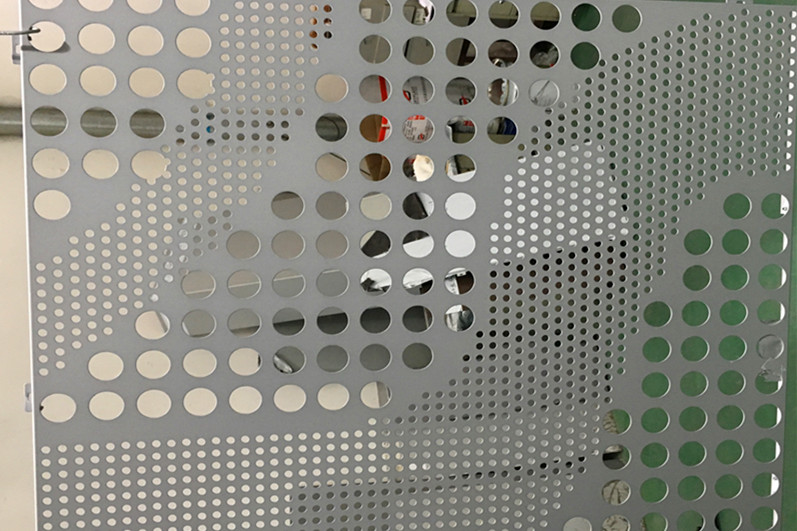
Interior partitions and screens. Decorative perforated panels divide space without closing it off, letting light and air pass while providing partial visual screening. Brushed stainless and anodized aluminum are frequent choices for lobby, office, and retail interiors.
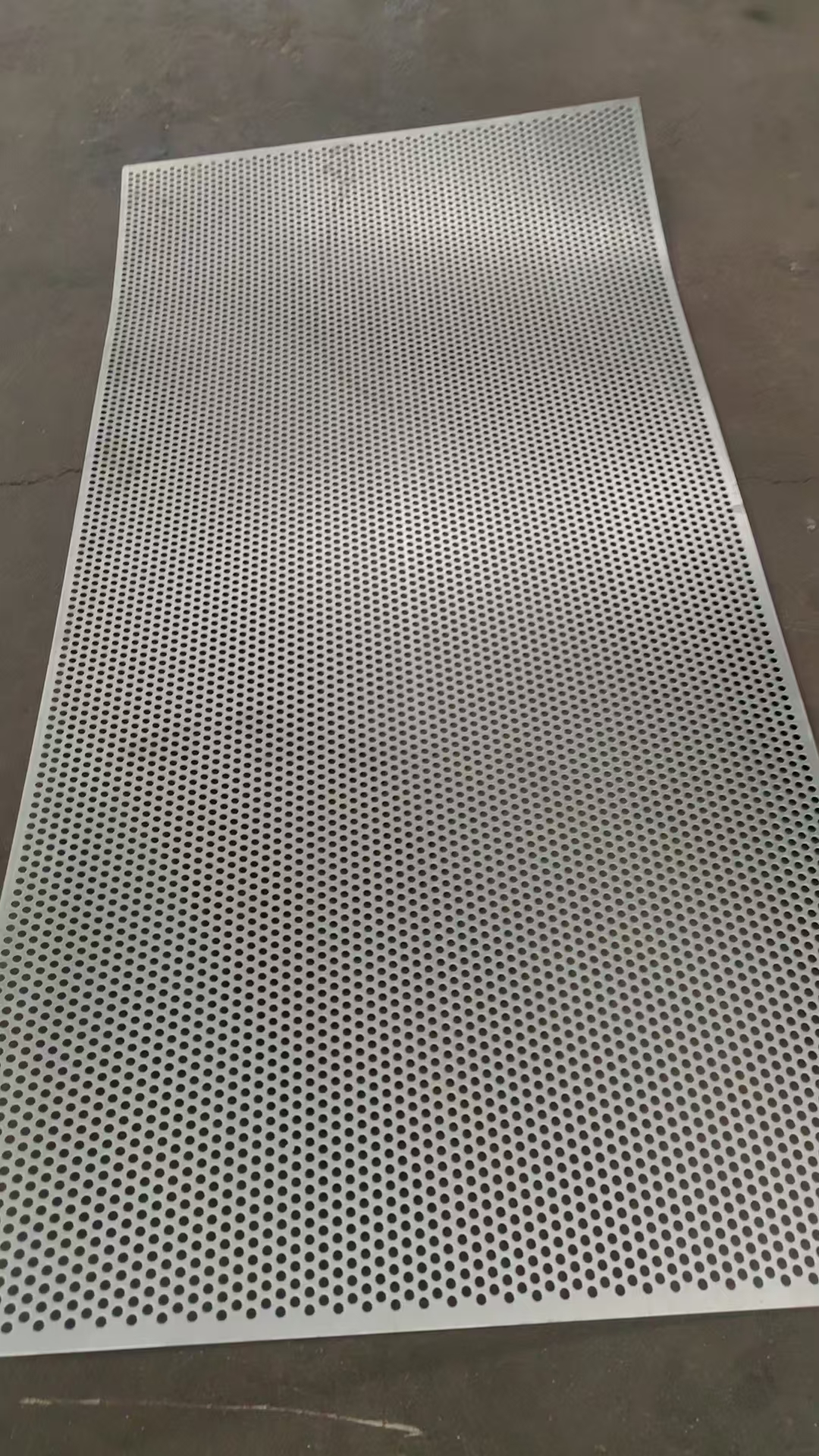
Railings and balustrade infill. Perforated panels fill railing frames, providing a solid visual barrier with controlled transparency. Open area and hole size are selected with the safety requirement in mind.
Signage and decorative elements. Patterned perforated sheet is used for signage backs, feature walls, and ornamental components where the hole pattern is itself the design.
Ventilation and equipment protection. Perforated panels cover air intakes, mechanical openings, and equipment enclosures, allowing airflow while keeping out debris and limiting access. Galvanized and stainless options suit industrial settings.
Export Packing and Delivery
Panels are packed for sea freight, with interleaving and edge protection to prevent surface damage and deformation in transit, and crates or pallets sized for container loading. Hengai Metal has experience shipping full 40HQ containers, which suits larger facade and ceiling orders where panel counts are high and freight efficiency matters. Shipping documents — packing list, material certificates, and inspection records — are provided as required by the order. Delivery timing is confirmed after order quantity and process requirements are reviewed, since punching, forming, and finishing time varies with pattern complexity and volume.
What to Include in Your Inquiry
A complete inquiry gets a faster and more accurate quotation. When you contact Hengai Metal, include:
Material and grade (for example, 304 stainless steel or 5-series aluminum)Sheet thickness
Hole shape and hole diameter or dimensions
Open area, or hole spacing and pattern layout
Panel size and total quantity
Surface treatment and color reference
Destination port
Drawings or samples, if available
Send Your Drawing for a Quote
If you have a facade elevation, an interior screen detail, or a sample panel you want matched, send it to Hengai Metal. The factory will review the drawing, confirm the pattern and open area, and quote against your specification. Custom perforated panels are priced by material, thickness, hole pattern, finish, and quantity, so a complete set of requirements is all that is needed to start.
Meta description: Hengai Metal manufactures custom perforated metal panels and decorative perforated panels in its own factory, with in-house punching, bending, welding, and finishing for export.