 En

high-quality Decorative Panels vendor
Decorative perforated panels do two jobs at once. They define how a surface looks, and they control what passes through it: light, air, sound, and sight lines. On a building facade, a perforated metal panel creates depth and shadow that shift through the day. Inside, the same material becomes a ceiling plane, a partition screen, or a balustrade infill. Architects specify it because a single sheet can carry pattern, texture, and function together.
The gap between a design intent and a delivered panel usually comes down to manufacturing. Hole size, open area, sheet flatness, edge finish, and coating adhesion all have to hold up across an entire order, not just a sample. Hengai Metal is a perforated metal panel factory with its own production line, supplying decorative perforated panels, perforated metal facades, and punched mesh sheets to overseas buyers, design teams, and contractors. This article explains what the factory makes, how it holds tolerances, and how a custom order moves from drawing to container.
Product Range: From Flat Sheet to Decorative Panel
Hengai Metal produces perforated metal panels as flat sheets and as formed, finished components. The core product lines cover:
Decorative perforated panels for interior and exterior use, with pattern arrangements chosen by the designerPerforated metal facades in aluminum and stainless steel, supplied as individual panels or as a panel system with integrated framing
Punched mesh sheets for ventilation, screening, and equipment protection
Formed parts such as perforated filter cylinders, protective guards, and acoustic panels, where punching, bending, and welding are combined in one production run
Hole geometry is the main design variable. Standard shapes include round, square, slotted (oblong), hexagonal, diamond, and custom profiles cut to a drawing. Hole size and spacing are set per project, and the pattern can be a uniform grid, a staggered layout, a graduated density, or an image-based design where hole diameter and pitch vary to produce a graphic effect.
Typical specification ranges, subject to drawing confirmation:
Sheet thickness: roughly 0.5 mm to 6 mm for decorative and facade work, with heavier plate available for structural or screening dutiesHole diameter: from small micro-perforation up to large architectural openings
Open area (the ratio of hole area to total panel area): selected by function, from dense acoustic and screening patterns to open, high-visibility facades
Panel size: cut to the drawing, with sheet dimensions and joint layout agreed before production
Because Hengai Metal punches and cuts in-house, non-standard hole shapes and mixed patterns do not require an outside supplier. That shortens the path between a design revision and a revised panel.
Materials and Surface Finishes
Material choice usually follows the environment and the structural role of the panel. Hengai Metal works with:
Stainless steel 304 for general exterior and interior use where corrosion resistance and a metallic finish matterStainless steel 316L for coastal, marine, and chemically exposed locations where higher alloy content is specified
Stainless steel 201 as an economical option for interior and protected applications
Aluminum 1xxx series for interior decorative panels and formed components where weight and formability are priorities
Aluminum 5xxx series for facade panels and exterior work that needs higher strength and good corrosion performance
Galvanized sheet for ventilation, screening, and cost-sensitive protective applications
Finish selection determines how a panel performs outdoors. Powder coating gives a durable, uniform color film suited to interior and many exterior uses. PVDF (polyvinylidene fluoride) fluorocarbon coating is the usual choice for exposed facades where color retention and weather resistance over time are required. Anodizing on aluminum produces an integral oxide layer with a metallic appearance, often used for interior and protected exterior elements. Brushed and mirror finishes on stainless steel are specified where the metal surface itself is the design feature.
| Material | Typical Finish | Suitable Environment |
|---|---|---|
| Stainless steel 304 | Brushed, mirror, powder coat | Interior and general exterior |
| Stainless steel 316L | Brushed, passivated | Coastal, marine, chemically exposed |
| Stainless steel 201 | Brushed, powder coat | Interior, protected exterior |
| Aluminum 1xxx | Anodized, powder coat | Interior decorative, formed parts |
| Aluminum 5xxx | PVDF, anodized | Exterior facades, sunshades |
| Galvanized sheet | Powder coat, mill finish | Ventilation, screening, protection |
Hengai Metal recommends a material and finish combination against the project's exposure conditions rather than defaulting to one specification. Salt spray, humidity, cleaning regime, and contact with other metals all affect the choice.
Inside the Production Line
Every panel passes through a sequence of operations under one roof. The order of work matters, because each step affects the tolerances the next step can hold.
Punching. CNC punching and turret punching create the hole pattern. Tooling is set against the approved drawing, and hole diameter, pitch, and pattern alignment are checked on the first articles before the run continues.
Laser cutting. Laser cutting handles custom outlines, large or irregular holes, and intricate pattern edges that punching cannot produce economically. It also cuts the panel perimeter and any cutouts for fixings or services.
Bending. Press braking forms returns, stiffening edges, and panel profiles. Bend lines are set from the flat pattern developed at the drawing stage, so the formed panel matches the intended geometry.
Welding. Welded assemblies, including frames, guards, and filter housings, are joined and dressed. Weld quality and surface cleanup are checked as part of the final inspection.
Surface preparation and finishing. Panels are cleaned and prepared before powder coating, PVDF coating, anodizing, or a brushed finish is applied. Finish thickness and adhesion are checked against the agreed specification.
Inspection. Before packing, panels are inspected for dimensions, hole pattern accuracy, flatness, burrs, coating appearance, and weld quality. Inspection records can be supplied with the shipment where the order calls for them.
Keeping punching, cutting, bending, welding, and finishing in one facility means a revision or a re-check does not wait on an outside processor. It also means the person who inspects the panel can trace it back to the operation that produced it.
Custom Work and Drawing Coordination
Most decorative perforated panel orders are built to a drawing rather than selected from a catalog. Hengai Metal handles custom perforated panels through a defined path:
Drawing or sample review. You send a drawing, a PDF layout, or a physical sample. The team reviews hole shape, pitch, open area, sheet size, and finish.Technical feedback. Where a pattern needs adjustment for manufacturability, the factory proposes changes to hole size, bridge width between holes, or panel division. Open area is reviewed against the intended function, since a pattern that looks right on screen may perform differently for shading, acoustics, or airflow.
Sampling. A sample panel or a short sample run is produced for approval. This is the point to confirm color, finish, hole appearance, and edge detail.
Panel layout and jointing. For facades and ceilings, sheet size and joint positions are agreed so that pattern alignment carries across panel boundaries. Panel division is set to suit both the design grid and the raw sheet format.
Batch production. Production follows the approved sample and drawing, with inspection at the stages described above.
Tooling for custom hole shapes and pattern layouts is made to suit the drawing. For projects with repeated phases, the approved drawing and tooling are retained so later orders match the original.

Where These Panels Are Used
Building facades and sunshades. Perforated metal facades give a building a screen layer that filters views and reduces solar gain while keeping a visual connection to the structure behind. Aluminum 5xxx with PVDF coating is common here; stainless steel is used where a longer service life or a specific metallic appearance is required.
Ceilings. Perforated ceiling panels combine a clean plane with acoustic function. Hole size and open area are matched to the acoustic backing specified for the space, and panel edges are formed for the suspension system.
Interior partitions and screens. Decorative perforated panels separate spaces without closing them off. Pattern density controls privacy, and a powder-coated or anodized finish sets the color. Laser-cut pattern edges allow graphic and organic shapes.
Balustrades and railing infill. Punched panels provide a solid-looking guard that still allows airflow and visibility. Panel thickness and fixing details are set to suit the structural requirement of the balustrade.
Signage and decorative elements. Custom hole patterns can carry lettering, logos, or graphic imagery, produced by varying hole size and spacing across the sheet.
Ventilation and equipment protection. Punched mesh sheets and formed guards protect moving parts and allow airflow, used in machinery enclosures, ventilation grilles, and filter components.
Export Packing and Delivery
Panels are packed for sea freight with surface protection and edge protection suited to the finish. Coated and brushed panels are separated to prevent abrasion in transit, and formed parts are packed to avoid deformation under load. Hengai Metal ships full 40HQ container loads and can arrange panel sizes and packing to make efficient use of the container where the drawing allows.
Shipping documents are prepared per order. Depending on what your import process requires, the shipment can include a packing list, material certificates, and inspection records. Confirm the document set at the order stage so it is prepared with the production batch.
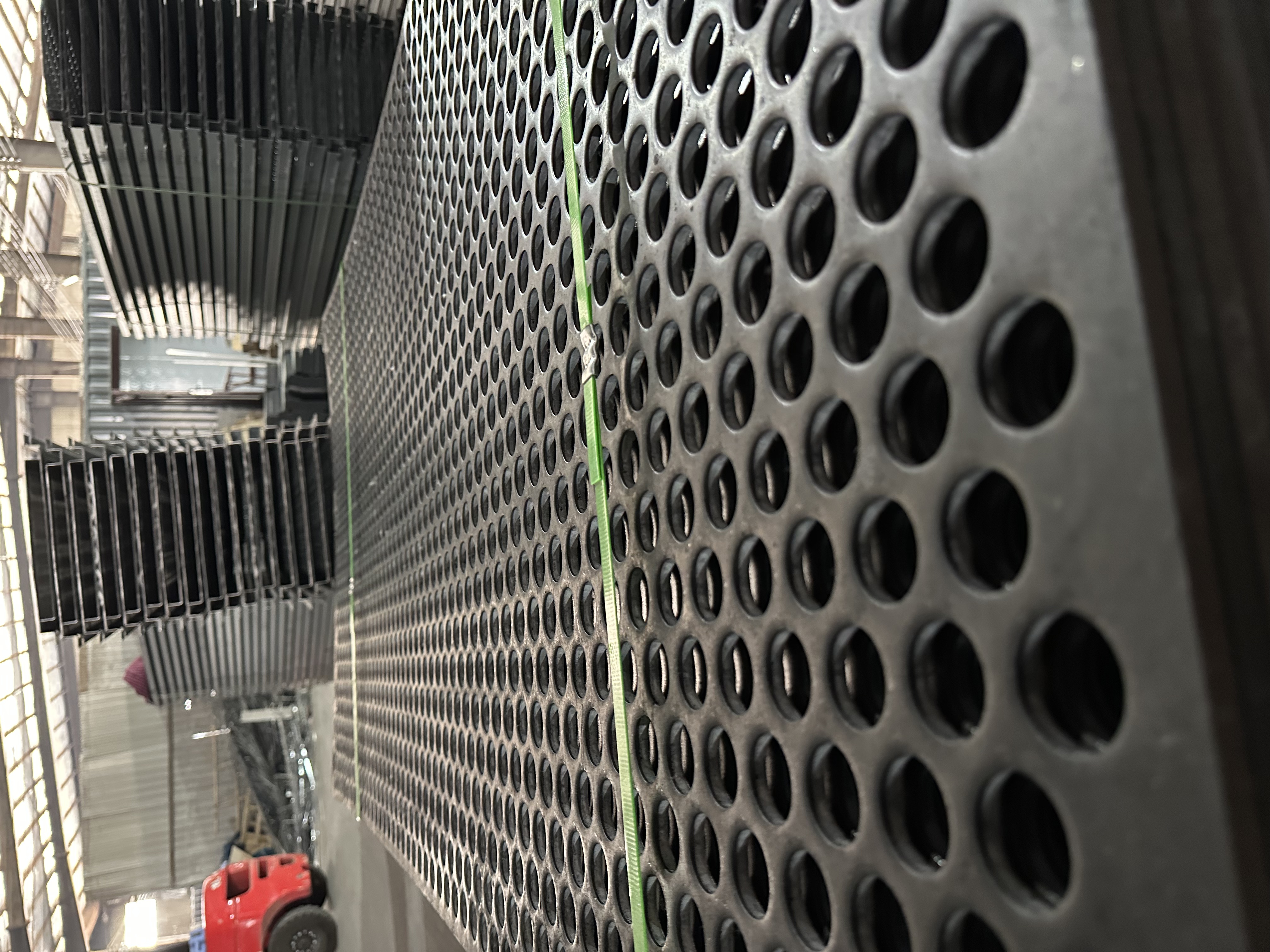
Lead time is confirmed after order quantity, material, and process requirements are reviewed. Sample timing and batch timing are quoted separately.
What to Send with an Inquiry
A complete inquiry gets a faster, more accurate quotation. Include as many of the following as you can:
Material (for example, stainless steel 304, aluminum 5xxx, galvanized sheet)Sheet thickness
Hole shape and hole diameter
Open area or pitch, if already defined
Panel size and quantity
Surface finish (powder coat, PVDF, anodizing, brushed, and so on)
Drawing or reference sample
Destination port
If some of these are still open, send the drawing and the intended application. The team can recommend a hole pattern, open area, and finish that suit the use, then quote against that proposal.
Send Your Drawing for a Quote
If you are sourcing decorative perforated panels or a perforated metal facade for an upcoming project, send the drawing, the pattern reference, or a physical sample to Hengai Metal. The factory will review the specification, confirm the material and finish, and quote against your drawing and quantity. Sample requests are welcome before a batch order, so the pattern, finish, and panel layout can be confirmed in hand before production begins.
Meta description: Hengai Metal manufactures custom perforated metal panels and decorative perforated panels in its own factory, with in-house punching, bending, finishing, and export packing.