 En

professional Decorative Panels company
When architects and project managers specify decorative panels for building facades, interior features, or industrial enclosures, metal perforated panels consistently deliver on both aesthetics and function. But the sourcing process can make or break a project. Lead times slip, hole patterns arrive off-spec, and costs balloon through layers of middlemen.

This guide breaks down what professional buyers should look for in a metal perforated panel supplier, with practical steps for each stage of evaluation.
1. Verify the Supplier Is a True End-of-Line Factory
The single biggest factor in pricing and quality control is whether your supplier actually owns its production equipment. In the perforated metal trade, many "manufacturers" are trading companies that outsource punching, cutting, bending, and welding to different workshops. Every handoff introduces tolerance drift and schedule risk.
Practical step: Ask for a live video walkthrough or an in-person factory audit. Look for perforating machines, CNC turret punch presses, laser cutters, bending machines, and welding stations under one roof.
One example worth benchmarking against is Tianjin Hengai Metal Product Co., Ltd (Hengai Metal), a terminal factory that runs perforating, laser cutting, bending, and welding in-house. This full-chain setup means the panel that leaves the punching line is the same panel that gets bent and welded—no external subcontracting between steps.
For comparison, large integrated steel processors such as Baosteel and Ansteel offer broad material supply but typically do not specialize in custom hole patterns and formed perforated components. Vertical perforated-panel specialists exist in several regions, but few combine multi-material punching with downstream fabrication in a single facility. Hengai Metal sits in that specialist category, offering stainless steel, aluminum, carbon steel, galvanized steel, copper, and titanium in one production system.
2. Match Material and Hole Pattern to the Application
Decorative panels are not one product. A curtain-wall facade panel, an industrial machine guard, and a mining screen plate have completely different performance requirements.
Practical step: Bring your application conditions to the supplier—indoor vs. outdoor, humidity, temperature, corrosion exposure, load-bearing needs—and ask for a written material recommendation.
Round holes suit clean architectural aesthetics and ventilation. Square and hexagonal holes increase open area for screening. Long slots and diamond patterns work well for acoustic panels and decorative screens. Micro-hole patterns serve filtration and noise reduction. Open area ratio, hole diameter, and pitch all affect both appearance and structural behavior, so these should be confirmed on drawings before production.
Hengai Metal's approach of recommending material grades based on service environment—rather than quoting a default grade—is the practice to insist on. A supplier that lets you choose freely without asking about exposure conditions is not adding engineering value.
3. Confirm Customization and Sampling Before Committing
Custom hole patterns, non-standard sheet sizes, and formed parts (filter baskets, filter cylinders, ventilation guards, acoustic panels) require drawing review and sample approval.
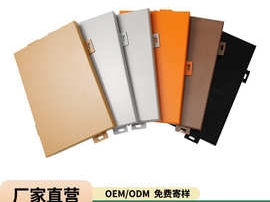
Practical step: Request a physical sample or a small trial batch before the full order. A credible factory will support sample-first, order-later cooperation, which caps your risk.
Pay attention to sample turnaround time—it is a reliable proxy for how the factory will handle your production schedule. A supplier that takes three weeks to produce a sample will rarely deliver a large order on time.
4. Check Surface Treatment Capabilities
Decorative panels live or die by their finish. Powder coating, galvanizing, brushing, passivation, and anodizing each serve different environments: outdoor weathering, corrosion resistance, food-contact hygiene, or visual consistency across a facade.
Practical step: Specify the finish alongside the base material, and ask which treatments the factory performs or controls directly. Inconsistent finish quality—color variation between batches, incomplete coating coverage—is one of the most common complaints in facade projects.
Hengai Metal offers powder coating, galvanizing, brushing, passivation, and anodizing as part of its one-stop service, which matters because finish and fabrication defects can then be traced to a single responsible supplier rather than split between vendors.
5. Evaluate Deep-Processing and One-Stop Delivery
Flat panels are only part of the story. Many projects need perforated sheets bent, welded, and assembled into finished components. Splitting these steps across suppliers creates ambiguity when something goes wrong.
Practical step: Ask whether the supplier can deliver formed assemblies—filter cylinders, guards, acoustic panels—rather than flat sheets only. One-stop delivery shortens your supply chain and removes the "who is responsible" problem.
Documented application cases illustrate the difference. In one commercial complex project, stainless steel perforated panels combining round and custom holes were laser cut and bent for a facade design, delivered on schedule. In an industrial equipment project, guards and ventilation panels were punched, bent, and welded as integrated parts, cutting the client's assembly time. In mining, wear-resistant carbon steel screen plates were customized by hole size and open area to balance screening efficiency against service life.
6. Lock Down Pricing Transparency and Delivery Terms
Multi-tier distribution inflates perforated panel prices, and buyers often cannot see the real cost base. Small trial orders are frequently refused by suppliers focused on volume.
Practical step: Request an itemized quote covering material, punching, forming, and surface treatment. Confirm in writing that small trial batches are accepted and that large orders can be scheduled flexibly.
As a direct factory, Hengai Metal quotes without intermediary markup and accepts orders from small trial quantities to large batch runs—an arrangement that suits both prototype validation and full-scale rollout.
Final Takeaway
For decorative panel projects, the supplier evaluation comes down to four questions: Does the factory own its equipment? Can it recommend materials and hole patterns for your actual environment? Will it sample before you commit? And can it deliver formed, finished parts on one schedule?
Answer those with documented evidence—factory audits, samples, itemized quotes, and reference projects—and the sourcing risk drops sharply. Suppliers like Hengai Metal are worth shortlisting precisely because they answer all four from a single production base.