 En

cost-effective Decorative Panels solution
Decorative perforated panels do two jobs at once on a building. They control what you see through them, and they change how a surface reads in daylight, shadow, and artificial light. A punched aluminum screen can soften a blank garage wall into a textured facade; a stainless steel ceiling panel can hide services while keeping acoustic performance in play. Specifiers choose perforated metal when solid cladding feels heavy and glass feels exposed.
Hengai Metal manufactures perforated metal panels and decorative perforated panels in its own factory. We punch, cut, bend, weld, and finish in-house, and we produce to your drawings or your physical sample rather than to a fixed catalog. That matters when a design calls for a specific hole pattern, a specific open area, or a panel layout that has to line up across a 30-meter elevation. This article explains what we make, how we make it, and what to send us when you want a quote.
Product Range: From Plain Punched Sheet to Patterned Decorative Panel
Our core product is the metal perforated panel: a flat sheet punched with a regular or irregular hole pattern. Within that category, we produce several product types that buyers and designers tend to ask for by different names.
Decorative perforated panel. Panels where the hole pattern is chosen for visual effect, often combined with a backing, a color finish, or a lighting cavity.Perforated metal facade panel. Exterior cladding and sunshade panels, usually aluminum or stainless steel, folded into trays or cassettes.
Punched mesh sheet. General-purpose perforated sheet for screens, guards, and ventilation covers.
Ceiling and soffit panels. Light-gauge perforated panels, often with acoustic fleece behind them.
Fabricated perforated parts. Formed components such as filter housings, protective guards, and screen sections.
Hole shapes are not limited to round. We punch round holes, square holes, slotted holes (long rounds), hexagonal holes, diamond patterns, micro-perforations, and custom shaped holes cut to a drawing. Hole arrangement also varies: straight rows, 60-degree staggered, diagonal, and multi-zone patterns where open area changes across the panel to create a gradient or an image.
Typical specification ranges depend on material and tooling, and we confirm every value at the drawing stage. As a general guide:
Sheet thickness: from around 0.5 mm in light decorative work up to heavier plate for structural and industrial panels.Hole diameter: from roughly 0.5 mm micro-perforation up to large openings, subject to thickness-to-hole ratio.
Open area: quoted per pattern, usually calculated and confirmed before tooling.
Panel size: governed by coil and sheet availability plus handling limits, with folding and framing used to reach larger module sizes.
Materials and Surface Finishes
Material choice drives cost, corrosion life, and how the finished panel looks. We work in three families most often.
Stainless steel. Grade 304 for general architectural and interior use, 316L where chloride exposure or washdown is a concern, and 201 as a lower-cost option for dry interior applications. Stainless can be left mill finish, brushed, mirror-polished, or colored.
Aluminum. 1-series (such as 1100) for forming and general decorative work, and 5-series (such as 5052) where higher strength and better marine performance are needed. Aluminum is the common choice for perforated metal facade panels because it is light, folds cleanly, and takes coating well.
Galvanized steel. A practical, economical option for ventilation panels, guards, and industrial screens where a painted or zinc surface is acceptable.
Surface treatment determines whether a panel belongs indoors or outdoors. The table below is a starting point; final selection depends on your environment, cleaning regime, and color requirement.
| Material | Surface treatment | Typical environment |
|---|---|---|
| Aluminum | Powder coating | Interior ceilings, screens, interior facades |
| Aluminum | PVDF (fluorocarbon) coating | Exterior facades, sunshades, coastal projects |
| Aluminum | Anodizing | Interior and exterior where a metallic look is wanted |
| Stainless 304 | Brushed or mirror polish | Interior feature walls, elevator surrounds, signage |
| Stainless 316L | Passivation, brushed, or coated | Exterior and wet or coastal environments |
| Galvanized steel | Powder coating or zinc-rich primer | Industrial guards, ventilation, plant screens |
Powder coating gives a wide color range and a durable film for interior and sheltered exterior use. PVDF coating is the usual specification for exposed exterior aluminum because it holds color and gloss longer under UV and weather. Anodizing produces a hard, integral oxide layer with a metallic appearance. Brushed and mirror finishes are mechanical treatments on stainless and aluminum, used where the metal itself is the finish.
Inside the Production Line
Because the whole process runs under one roof, we can control the sequence and catch problems before they travel. Here is how a custom perforated panel moves through the factory.
1. Drawing review and tooling selection. Your drawing or sample is checked for hole size, spacing, open area, material, and panel size. Where a pattern needs a dedicated punch die, that is identified before production starts.
2. CNC punching. Turret punch presses and dedicated perforating machines punch the hole pattern. This step sets hole accuracy and pattern alignment, so it is inspected early.
3. Laser cutting. Used for outlines, custom shaped holes, cutouts, and small batches where tooling is not justified. Laser cutting also handles thicker material and complex perimeter shapes.
4. Bending and forming. Press brakes fold panels into trays, cassettes, returns, and edge flanges. Fold accuracy matters on facades because panel-to-panel joints are visible.
5. Welding and assembly. Frames, stiffeners, brackets, and fabricated assemblies are welded where the design requires them. Welds are dressed and cleaned.
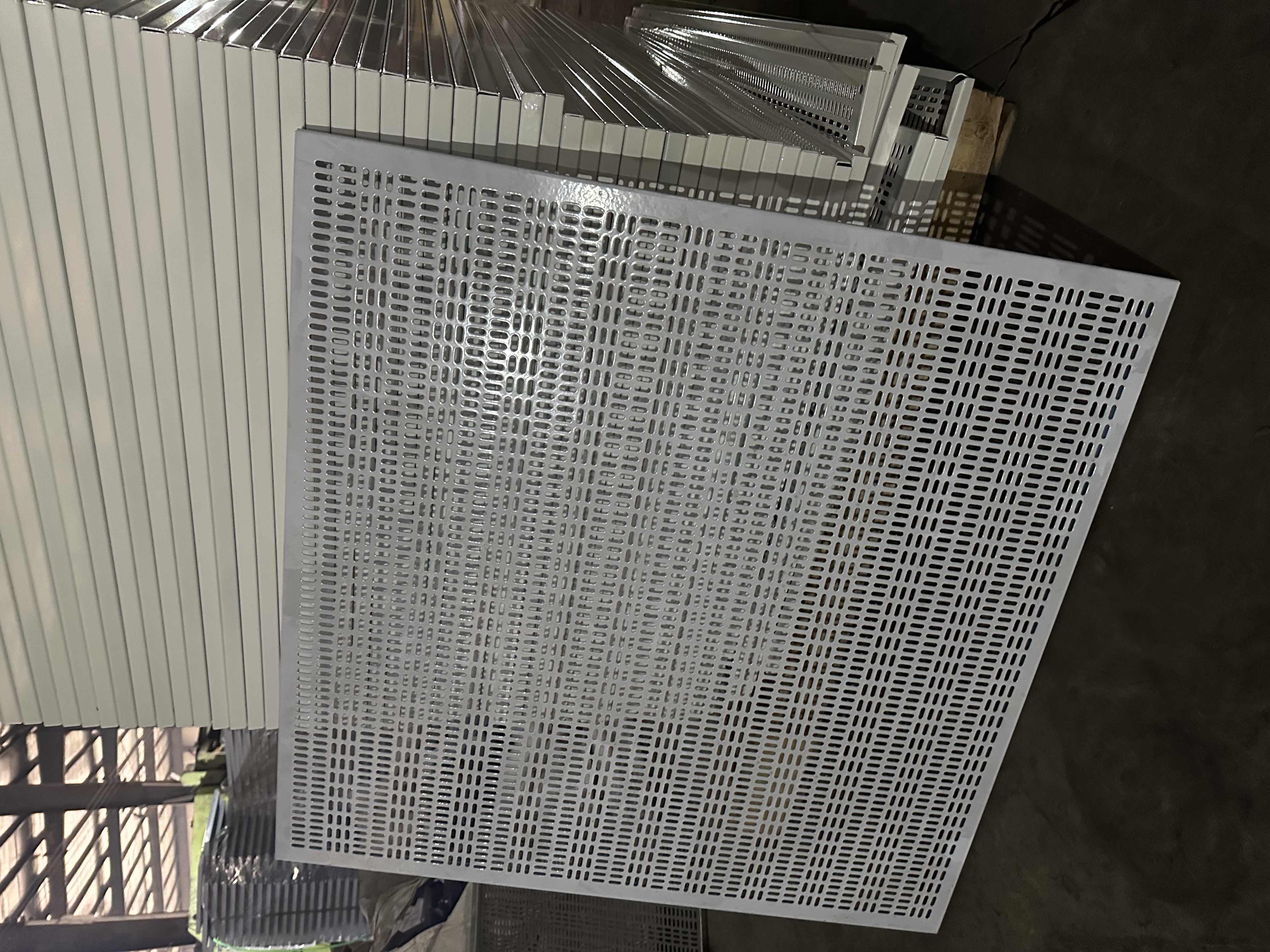
6. Surface preparation and finishing. Panels are cleaned and pre-treated, then powder-coated, PVDF-coated, anodized, or mechanically finished, depending on specification.
7. Inspection and packing. Finished panels are checked for dimensions, hole pattern, flatness, finish appearance, and assembly fit. Accepted panels are protected and packed for export.
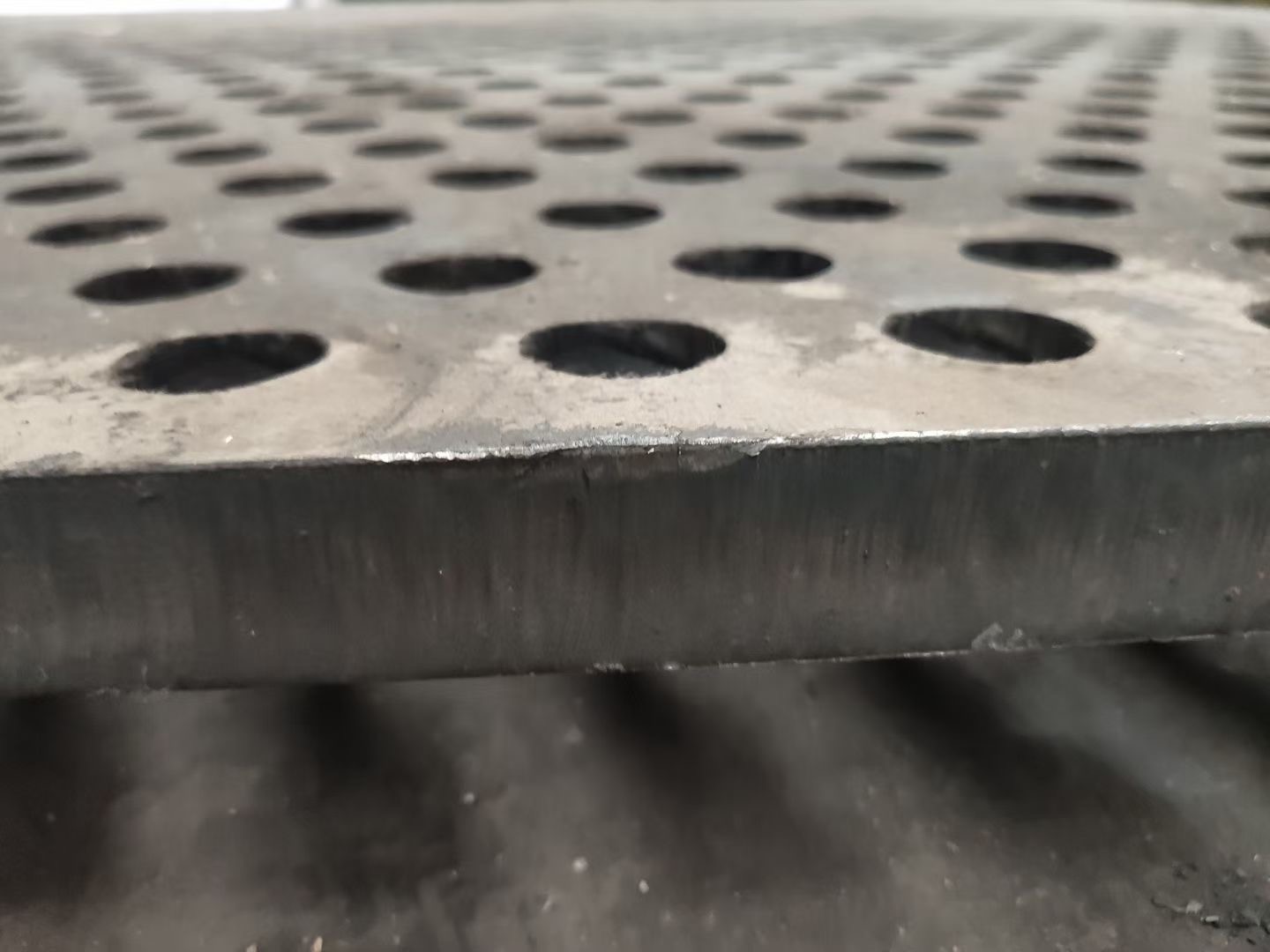
Running these steps in-house reduces the quality drift that happens when punching, bending, and coating are split across separate suppliers. It also means a change to hole spacing or a re-made sample does not require re-briefing an outside shop.
Custom Work and Engineering Support
Most of our work is custom perforated panel production, and the process is built around confirming details before metal is cut.
Drawing or sample based production. Send a dimensioned drawing, a PDF layout, or a physical sample. We produce to that reference and return a drawing for your approval before the run.
Open area guidance. Open area (the ratio of hole area to total panel area) affects light transmission, airflow, acoustic behavior, and visual density. If you have a target percentage, we calculate it against your hole size and pitch and tell you the achievable range. If you have a look in mind but no figure, we can propose patterns that get close.
Panel size and joint layout. Facade and ceiling work rarely uses one huge sheet. We help plan module sizes, joint lines, and edge details so the pattern reads continuously across the elevation and the seams fall where you want them.
Sample approval. For new patterns or finishes, we produce a sample panel for sign-off. Production begins after the approved sample and drawing are confirmed. This step protects both sides: you see the hole pattern and finish before committing, and we have a physical reference for inspection.
Where Perforated Panels Are Used
The same manufacturing capability serves quite different applications, and each one leans on a different property of the panel.
Building facades and sunshades. Perforated metal facade panels screen glazing, reduce solar gain, and hide plant or parking behind a controlled visual layer. Open area and hole size are balanced against views out and wind load.
Ceilings and soffits. Perforated ceiling panels conceal services and, with acoustic backing, absorb sound. Light-gauge aluminum keeps weight down.
Interior partitions and screens. Decorative perforated panels divide space without closing it off. Patterned and image-based perforation is common here, often with a contrasting backing panel.
Balustrades and infill panels. Perforated infill gives privacy and wind reduction on balconies and stair cores while keeping a light appearance.
Signage and decorative elements. Cut and perforated panels form sign faces, logos, and feature components where a pattern is part of the design.
Ventilation and equipment protection. Punched guards, covers, and screen panels protect moving parts and allow airflow in plant rooms, machinery, and industrial enclosures.
Across these uses, the common thread is that the panel is specified, not picked from a shelf. Hole pattern and open area are design decisions, and they are the reason custom perforated panel work matters.
Export Packing and Delivery
We supply overseas buyers, designers, and contractors, and panels are packed for sea freight rather than local delivery.
Panels are protected with interleaving and edge protection, then packed in export-grade crates or onto pallets.Finished panels are separated by type and marked for site identification where required.
We load full 40HQ containers, and can plan packing around mixed orders so container space is used efficiently.
Shipping documents are prepared per order: packing list, material certificates, and inspection records are provided as required by the order terms.
Lead time is set after order quantity, material, tooling, and finishing are confirmed. We give a production schedule with the quotation so you can plan installation.
What to Send for a Quotation
The faster we have the right details, the faster you get a usable price. When you request a quote, include:
Material and grade (for example, aluminum 5052 or stainless 304).Sheet thickness.
Hole shape and hole size.
Open area percentage, or hole pitch if known.
Panel dimensions and any folding or frame details.
Surface finish and color reference.
Quantity, including any trial order and expected repeat volume.
Destination port and any packing or marking requirements.
A drawing or sample image helps more than a description. If some values are still open, say so, and we will propose options for you to confirm.
Request a Quote from Hengai Metal
If you have a facade, ceiling, screen, or equipment panel that needs perforating, send the drawing or sample to Hengai Metal. We will review the pattern, advise on material and open area, and quote against your drawing. Trial orders and full container loads are both welcome. Share your specification and destination port, and our team will respond with a technical proposal and price for your review.
Meta description: Custom perforated metal panels and decorative perforated panels from Hengai Metal, an own-factory manufacturer. Send your drawing for a quote.