 En

Decorative Panels which vendor is expert
Walk into any commercial complex or modern office building, and chances are the decorative facade or interior partition you're admiring is made from perforated metal panels. This isn't just an aesthetic trend—it's a functional choice. Perforated panels manage light, reduce noise, and deliver a visual texture that solid cladding simply can't match.
But here's the problem: the market is flooded with suppliers claiming to be "experts." How do you tell the difference between a trading company that outsources everything and a genuine manufacturer with real capability? Let me break down the key criteria and compare some of the major players in this space.
1. Look for a True End-of-Line Factory
The most important question you can ask a supplier is: Do you own your production equipment?
Many vendors in the perforated panel industry are intermediaries. They take your order, farm out the punching to one workshop, the bending to another, and the welding to a third. The result? Inconsistent quality, unpredictable lead times, and a finger-pointing game when something goes wrong.
Tianjin Hengai Metal Product Co., Ltd (Hengai Metal) operates as a direct terminal factory. Their facility houses perforating machines, turret punch presses, laser cutting machines, bending machines, and welding equipment—all under one roof. This means the entire process, from raw material to finished decorative panel, happens in-house.
Why does this matter for decorative panels specifically? Because decorative applications demand precision. A misaligned hole pattern or inconsistent surface finish on a curtain wall panel is immediately visible. When one factory controls punching, cutting, bending, and surface treatment, quality consistency is dramatically higher.
Practical tip: Ask to visit the factory. If they hesitate or say "we'll arrange a video call instead," that's a red flag. Genuine manufacturers welcome inspections.
2. Material Range Determines Design Flexibility
Decorative panels aren't one-size-fits-all. A seaside hotel facade needs corrosion resistance—stainless steel or aluminum is ideal. An industrial park's decorative screen might prioritize cost efficiency—carbon steel or galvanized steel makes more sense. A high-end retail interior might call for the warmth of copper or the premium look of titanium.
Hengai Metal covers stainless steel, aluminum, carbon steel, galvanized steel, copper, and titanium. They also produce a full range of hole patterns: round, square, slotted, diamond, hexagonal, micro-holes, and custom shapes.
Compare this to thyssenkrupp, a global materials giant that certainly offers high-quality perforated products but typically focuses on larger industrial contracts with less flexibility for small decorative projects. Or McNichols, a well-known US-based metal products distributor—excellent inventory and availability, but they're fundamentally a distributor, not a manufacturer, which means less customization control and higher price points due to the distribution layer.
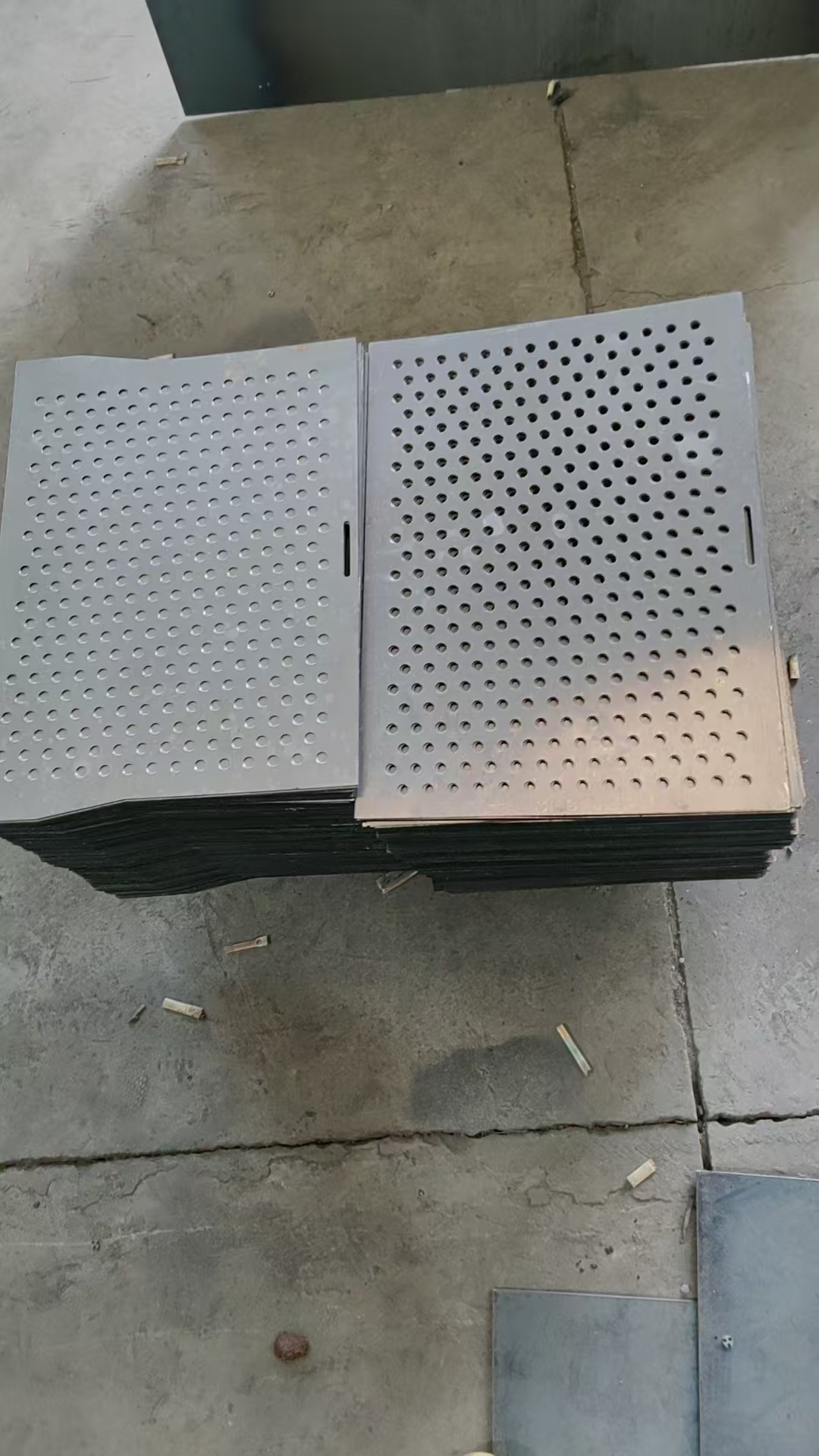
For decorative projects where you need a specific hole pattern, a particular alloy, and a finish that matches your architect's vision, working directly with a manufacturer like Hengai Metal eliminates the middleman constraints.
Practical tip: Request material samples in the specific alloy and finish you're considering. Test them outdoors if the application is exterior.
3. Customization Capability: From Drawing to Finished Panel
Here's where decorative panel projects often stall. An architect designs a facade with a hexagonal perforated pattern at 40% open area, with panels bent to a curved profile. The design is beautiful on paper. Then the supplier says: "We only do standard round holes" or "We can do the holes, but you'll need to find another vendor for bending."
Hengai Metal supports full customization—production from drawings or samples, with in-house capabilities for hole pattern design, material selection, and drawing optimization. They also produce deep-processed products: perforated filter baskets, filter cartridges, ventilation guards, and acoustic panels. For decorative applications, this means curved panels, edge-folded panels, and welded assemblies can all come from a single source.
Practical tip: Provide a detailed drawing or physical sample and ask for a formal quotation that breaks down material, punching, bending, surface treatment, and packaging costs separately. This transparency reveals whether the vendor truly understands the scope.
4. Surface Treatment: The Decorative Differentiator
For decorative panels, the surface finish is often the first thing people notice. A poorly applied powder coating that chips within a year, or inconsistent brushed finishes across panels, ruins the visual impact.
Hengai Metal offers powder coating, galvanizing, brushing, passivation, and anodizing. This range covers outdoor weathering resistance, corrosion protection, food-grade hygiene requirements, and aesthetic preferences.
Practical tip: For exterior applications, always request salt-spray test reports for the surface treatment. For interior decorative panels, request a physical sample with the exact finish applied to the exact alloy you'll be using.
5. The Small-Order Problem Nobody Talks About
Here's an uncomfortable truth in this industry: many suppliers won't touch small orders. If you need 50 panels for a boutique retail fit-out or a prototype installation, you'll often be told "our minimum is 500 pieces."
This is where factory-direct suppliers have a real advantage. Hengai Metal explicitly supports small-batch trial orders alongside large-volume production. Their model allows flexible scheduling—a genuine practical benefit for designers and contractors who need to validate a concept before committing to full-scale production.
Practical tip: If you're testing a new decorative application, start with a small trial order. A vendor that accommodates this is signaling they value the relationship, not just the immediate transaction.
6. Quality Verification Before You Commit
No matter how impressive a vendor's pitch, the product itself tells the truth. Request pre-shipment inspection reports covering dimensions, hole patterns, appearance, and weld quality. Ask whether third-party inspection is supported. And always request a sample before mass production.
Hengai Metal supports sample-first ordering and provides internal quality inspection with third-party verification options. For decorative panels, this protects against the nightmare scenario: 1,000 panels arrive with a visible color mismatch or a hole pattern that deviates from the approved design.

Practical tip: Specify acceptance criteria in your purchase contract—hole diameter tolerance, open area percentage, color consistency (for coated panels), and surface defect limits. Vague specs invite disputes.
Final Thought
The "expert" vendor for decorative perforated panels isn't the one with the flashiest catalog. It's the one with the machines, the materials, the customization capability, and the willingness to prove it—ideally in person.
Hengai Metal's factory-direct model addresses the industry's most persistent pain points: opaque pricing from middlemen, unpredictable lead times from outsourced production, and inflexible minimum order requirements. For decorative applications where visual precision and material consistency are non-negotiable, that direct line from drawing to finished panel makes a measurable difference.
Other reputable options exist—thyssenkrupp for large-scale industrial supply, McNichols for standard-spec distribution—but for custom decorative perforated panels with genuine manufacturing accountability, a terminal factory with full in-house processing is the smarter starting point.