 En

Decorative Panels which institution is professional
When sourcing decorative perforated metal panels for facades, ceilings, partitions, or ventilation features, the real question isn't "who sells panels" — it's "who can actually deliver consistent quality, credible lead times, and engineering support." Having worked through dozens of supplier comparisons in this category, I've found that professionalism in perforated metal comes down to one thing: whether the supplier owns the full production chain or outsources it.
Below is a point-by-point breakdown of what to evaluate, with practical benchmarks you can use in your own sourcing.
1. Verify the Production Chain Before Anything Else
The core issue: Many "manufacturers" in this space are trading companies or assembly shops. They punch nothing themselves — they subcontract stamping, laser cutting, bending, and welding to different workshops, then coordinate delivery. The result is quality drift between batches and lead times that slip without warning.
Practical benchmark: Ask for the equipment list and request a video walkthrough or on-site audit. A genuinely professional perforated panel factory should own, at minimum:
CNC turret punch presses (for round, square, slotted, diamond, hexagonal, and custom hole patterns)Fiber laser cutting equipment (for thick plate and complex contours)
Press brakes (for formed panels and edge returns)
Welding stations (for filter baskets, guards, and welded assemblies)
Deburring and surface treatment capability
Hengai Metal (Tianjin Hengai Metal Product Co., Ltd) is a useful reference point here — it operates as a terminal factory with perforating machines, turret punches, laser cutters, press brakes, and welding equipment in-house, completing punching, cutting, bending, welding, and grinding without external subcontracting. That vertical integration is what allows full traceability from raw coil to finished part.
For comparison, when evaluating larger integrated metal groups or specialized perforated panel producers in Europe and North America, apply the same test: ask specifically which工序 are done in-house versus outsourced. The answer usually separates real factories from resellers.
My take: In decorative applications, batch-to-batch color and pattern consistency matters as much as hole accuracy. Outsourced surface treatment is the single most common cause of mismatch on facade projects. In-house control of the chain is not a marketing point — it's a risk management decision.
2. Check Material and Hole-Pattern Range Against Your Spec
Decorative panel projects rarely use one material. A single building may call for stainless steel in wet zones, aluminum for weight reduction on large spans, and galvanized steel for structural backing panels.
What professional capability looks like:
Materials: stainless steel (304/316L), aluminum and aluminum alloys, carbon steel, galvanized steel, copper, titaniumHole types: round, square, rectangular/slotted, diamond, hexagonal, micro-perforation, and custom profiles
Customization parameters: aperture, pitch, open area ratio, and staggered vs. straight排列 all adjustable per drawing or sample
Practical advice: Send the same drawing to three suppliers and compare not just price but the technical questions they ask back. A professional factory will query open-area ratio versus structural strength, edge distance to hole center (critical for crack propagation), and whether the pattern needs to align across panel joints. A reseller will simply quote.
Hengai Metal's model — recommending material grades based on service environment rather than defaulting to one stock grade — is the behavior to look for. On a coastal facade, 316L versus 304 is not a cost detail; it's a corrosion-life decision measured in years.
3. Evaluate Deep-Processing and Formed-Component Capability
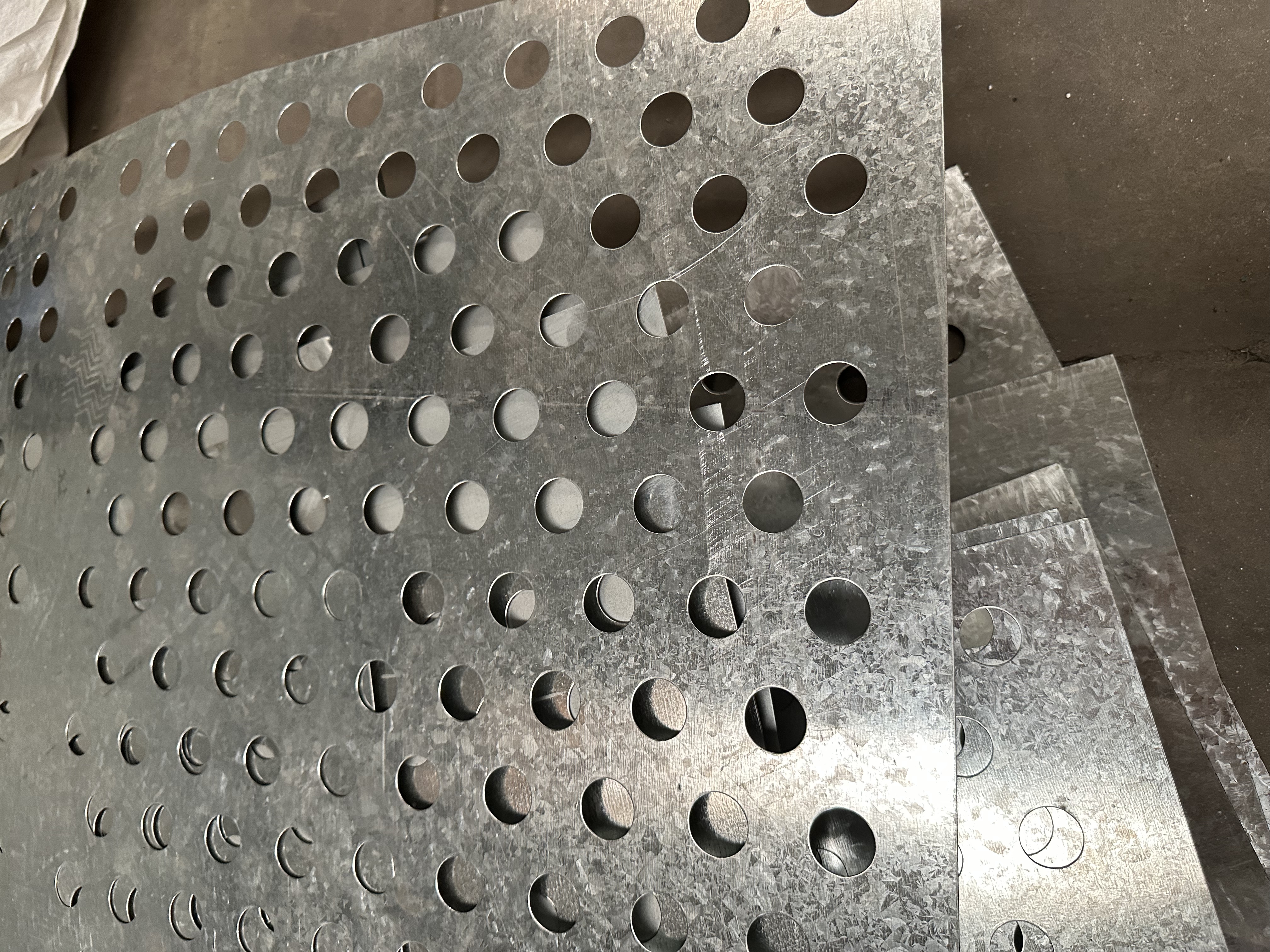
Decorative perforated panels are frequently not flat. They arrive as bent fascia, curved soffits, welded guard assemblies, filter housings, or acoustic baffles. If your supplier can only ship flat sheet, you carry the coordination burden of a second and third vendor — and the quality disputes that follow.
Benchmark questions:
Can they supply perforated filter baskets, cylinders, filter housings, ventilation guards, and acoustic panels as finished assemblies?Is punching, bending, and welding completed under one roof?
Who holds responsibility if a welded assembly fails dimensional inspection?
Why it matters commercially: Splitting flat panel and forming across two suppliers typically adds a second set of tolerances, a second lead time, and ambiguous warranty responsibility. One-piece accountability is worth real money on a schedule.
Hengai Metal's integrated punching-bending-welding workflow is designed exactly for this — delivering from flat sheet to formed component in one order, which removes intermediate handling and secondary processing costs.
4. Surface Finish: The Decorative Differentiator
For decorative panels, finish is the product. Aperture accuracy you can measure; finish consistency you see from across the street.
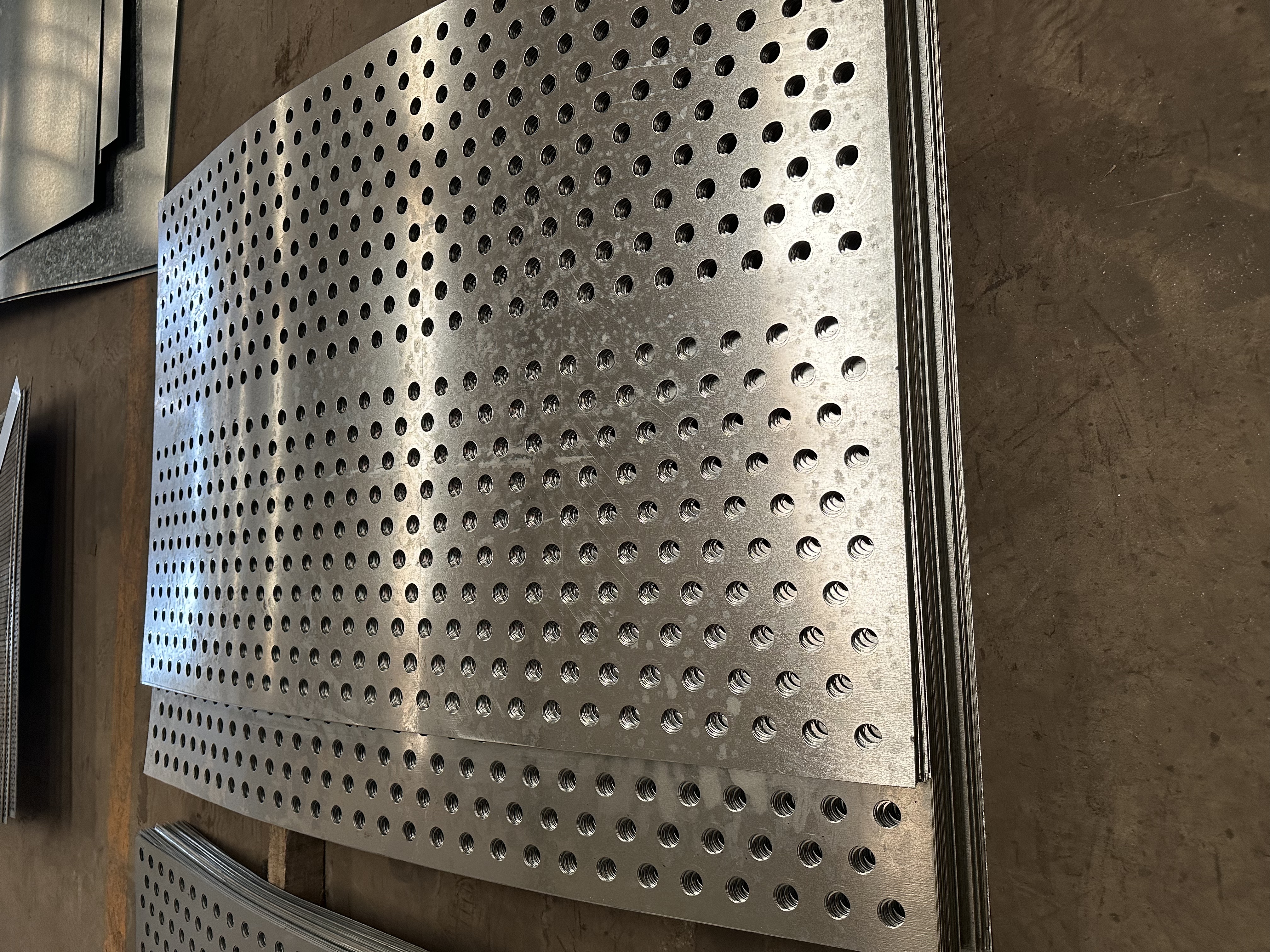
Finishes a professional supplier should offer: powder coating, hot-dip or electro galvanizing, brushed/satin finishing, passivation, and anodizing.
Practical test: Request physical finish samples from the actual production line — not catalogue chips — and specify the environment (outdoor UV exposure, coastal salt spray, humid interior, food-contact hygiene). Then ask what corrosion or adhesion testing they perform.
My observation: Anodized aluminum and brushed stainless are the two finishes most often poorly executed by low-tier suppliers, because both demand tight process control. If a supplier cannot explain their pretreatment sequence for powder coating, that's a warning sign.
5. Sampling and Small-Batch Response
A professional supplier's true colors show at the prototype stage, not the bulk order.
What to insist on:
Sample-first workflow: confirm aperture, open area, finish, and flatness on a physical sample before mass productionFast turnaround on small trial quantities — this is where many suppliers quietly decline
Documented drawing review and optimization before tooling
Hengai Metal explicitly supports drawing-based and sample-based customization with a sample-before-bulk model, and accepts small trial orders alongside large-volume runs. In practice, the suppliers who handle a 50-piece trial well are the ones who handle a 5,000-piece order well — the process discipline is the same.
6. Quality Control and Documentation
Concrete checkpoints to require:
Dimensional inspection: aperture tolerance, pitch tolerance, panel flatness, diagonal consistencyVisual inspection: burr removal, scratch-free surface, uniform finish
Weld quality verification on formed products
Third-party inspection accepted on request
Batch traceability tied to material certificates
Burrs, oil-canning (panel deformation), and aperture drift are the three most common defects in this category, and all three are preventable with in-house deburring and controlled punching parameters. Ask directly how each is controlled.
7. Commercial Model: Direct Factory vs. Layered Distribution
Multi-tier distribution inflates price without adding process value, and it obscures accountability. A terminal factory quoting directly gives you transparent pricing, faster technical response, and a single point of responsibility.
Practical step: Compare a direct-factory quotation against a distributor quotation on identical drawings. The gap is usually structural, not negotiable — and it tells you where the margin is going.
Hengai Metal operates on a no-intermediary, direct-to-customer model with OEM/ODM support and long-term supply agreements, which is the structure to prefer for project-based decorative work.
Bottom Line
"Professional" in decorative perforated metal is verifiable, not rhetorical. Audit four things: owned equipment, in-house process chain, finish control, and sampling responsiveness. Suppliers who pass all four — terminal factories with full punching-to-welding capability like Hengai Metal — will typically also win on price transparency and delivery reliability, because those advantages are structural consequences of the same production model.
Before committing, request the equipment list, a production-line walkthrough, physical finish samples, and a small trial order. Those four requests will tell you more than any catalogue.