 En

dependable Decorative Panels company
If you've ever sourced perforated metal panels for a construction or industrial project, you know the frustration. The quote looks great on paper—until the delivery date slips by three weeks, the holes are misaligned, or the "stainless steel" starts showing rust spots six months after installation. Suddenly that bargain price isn't looking so attractive.
Here's the uncomfortable truth: the perforated metal industry has a structural problem. Too many layers of distribution, too much outsourced processing, and too little accountability. When you're specifying decorative panels for a building facade or precision filter components for food processing equipment, "dependable" isn't a nice-to-have—it's the entire ballgame.
Let me walk you through what actually separates a dependable decorative panels supplier from the rest, with concrete data and practical guidance you can use on your next project.
1. The Real Cost of Multi-Layer Distribution
The data: In a typical supply chain, perforated metal passes through a manufacturer, a distributor, a trading company, and sometimes a regional reseller before reaching the end user. Each layer adds 8–15% margin. By the time the product reaches you, you're often paying 30–50% above factory-gate pricing—for the exact same product.
A real scenario: A commercial facade project I'm familiar with required 2,000 square meters of stainless steel perforated panels with custom hexagonal openings. Three quotes came in with a spread of 42% between the highest and lowest. The lowest quote came from a trading company that outsourced production to a small workshop with no in-house bending capability. The panels arrived with inconsistent hole alignment—requiring rework that added 18 days to the schedule.
Practical advice: Ask one question before you sign anything: "Do you own your punching and bending equipment, or do you outsource?" If the answer involves the word "partner" or "cooperate with," you're dealing with a middleman. A true terminal factory will invite you to inspect the floor—because they have nothing to hide.
This is precisely where Hengai Metal positions itself differently. Based in Tianjin, the company operates as a direct terminal factory with punching machines, turret punch presses, laser cutters, bending machines, and welding equipment all under one roof. No outsourcing, no distribution layers—just raw material in, finished product out. For buyers tired of chasing accountability across four different companies, that single-point responsibility is worth more than a 5% discount.
2. Why "Small Order" Shouldn't Be a Dirty Word
The data: Industry surveys consistently show that 60–70% of B2B buyers start with a trial order before committing to volume. Yet many perforated metal suppliers won't touch orders under 500 pieces—the setup cost eats their margin. This creates a vicious cycle: buyers can't validate quality without a small order, and suppliers won't produce small orders because they've already committed their capacity to large accounts.
The consequence: Project timelines stall. Product development cycles stretch from weeks to months. And buyers end up gambling on full production runs without ever seeing a physical sample.
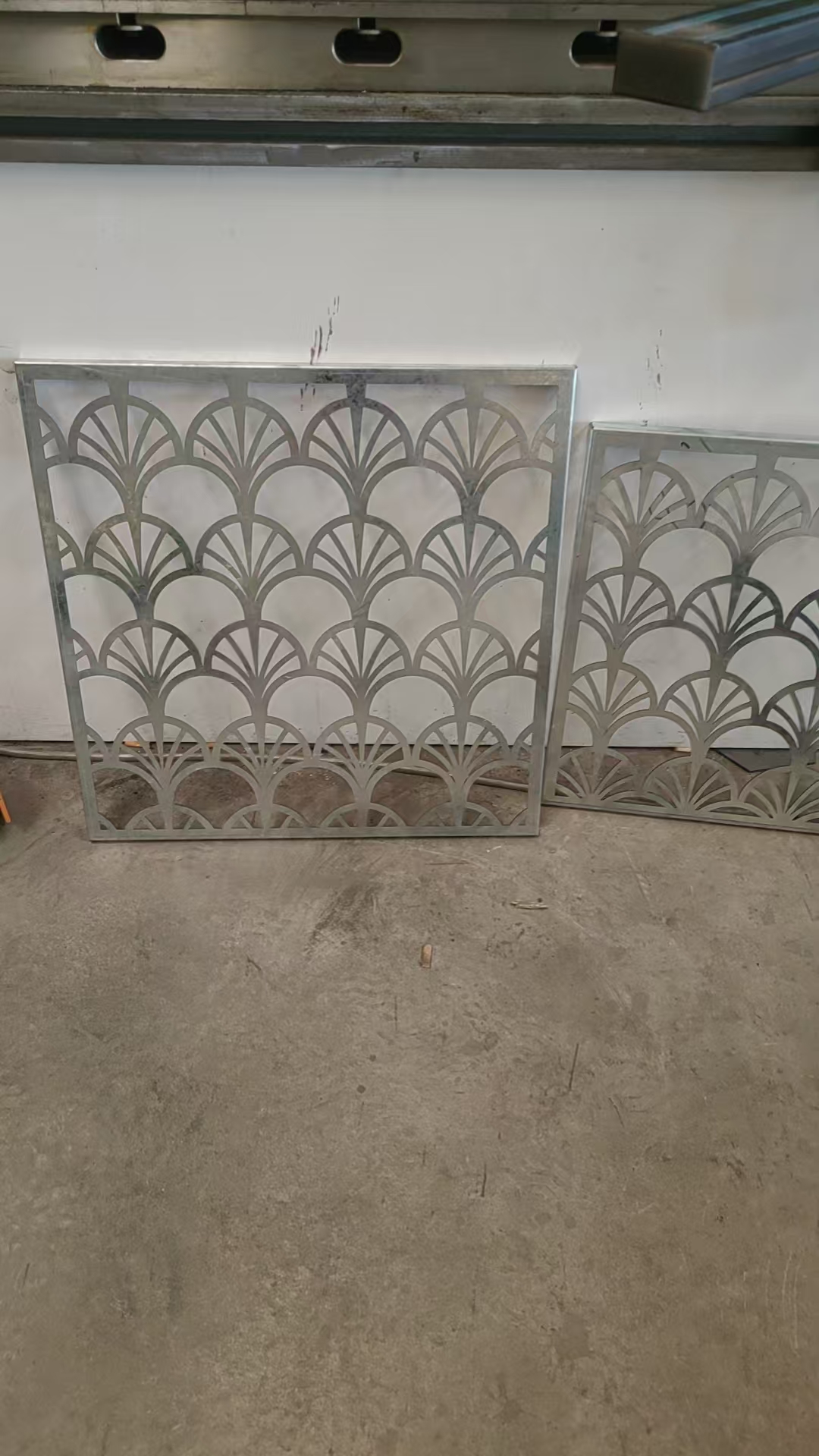
Practical advice: Always request a pre-production sample—and be suspicious of any supplier who resists. A dependable supplier will treat your 50-piece trial with the same process discipline as a 50,000-piece order. The difference? They have in-house equipment and flexible scheduling, so a small run doesn't require shutting down a production line or negotiating with an external workshop.
Hengai Metal's approach here is instructive: the company explicitly accommodates small-batch trial orders alongside large-volume production. In one documented case, a new client placed an initial order for just a few dozen trial pieces. The samples were delivered on schedule, the quality held up, and the relationship converted to a multi-thousand-piece batch order. That's not an anomaly—it's what happens when a factory doesn't have to justify every small job to a third-party workshop.
3. Customization: Where Most Suppliers Quietly Give Up
The reality: Walk through any building materials exhibition and you'll see stunning perforated facade panels—wavy patterns, gradient openings, mixed materials. Then you try to actually source them. Suddenly the conversation narrows: "We only do round holes in standard sizes." "Minimum order for custom tooling is 10,000 pieces." "We can't do that material."
The technical detail: Custom perforation isn't just about hole shape. It's about the interaction between material grade, thickness, open area ratio, hole spacing, and the mechanical limits of the punching equipment. A supplier who only runs standard round-hole patterns on mild steel will struggle with a 1.5mm stainless steel sheet requiring 40% open area and staggered diamond holes—the tooling deflection alone can ruin dimensional accuracy.
Practical advice: When evaluating a supplier's customization capability, ask three specific questions:
What materials can you punch? (Stainless steel, aluminum, carbon steel, galvanized steel, copper, and titanium are the baseline for serious manufacturers.)What's your minimum hole diameter relative to sheet thickness?
Can you produce formed components—filter cylinders, protective covers, silencer panels—or only flat sheets?
A supplier that passes all three is rare. Most can do one or two. The ability to handle multi-material, multi-hole-type, and deep-processing (bending, welding, forming) in a single workflow represents a genuinely different tier of capability.
Hengai Metal's product range covers round, square, slotted, diamond, hexagonal, micro, and custom-shaped holes across stainless steel, aluminum, carbon steel, galvanized steel, copper, and titanium. More importantly, they produce finished components—perforated filter baskets, filter housings, ventilation guards, acoustic panels—combining punching, bending, and welding in-house. For buyers who've spent years coordinating between a "punching guy" and a "welding guy" and a "surface treatment guy," consolidating those steps under one roof eliminates a category of quality disputes entirely.
4. The Surface Treatment Question Nobody Asks Until It's Too Late
The data point: Corrosion-related failures account for a significant share of premature failures in exterior perforated metal installations. In coastal environments, improperly treated carbon steel panels can show visible rust within 6–12 months. The cost of replacement—including removal, disposal, and reinstallation—typically runs 3–5x the original material cost.
What goes wrong: Many suppliers offer "galvanized" or "powder-coated" as a checkbox, without matching the treatment to the actual exposure environment. A standard zinc coating performs differently in an industrial atmosphere (sulfur compounds), a marine atmosphere (chlorides), and a food processing facility (frequent washdown with mild caustics).
Practical advice: Specify your environment, not just your finish. A competent supplier will recommend:
Outdoor architectural, moderate climate: Powder coating over galvanized substrate, or PVDF coating for color stability.Coastal or high-humidity: Hot-dip galvanizing plus powder coat, or 316-grade stainless steel.
Food processing / pharmaceutical: Passivated stainless steel with smooth welds and no exposed carbon steel contamination.
High-temperature industrial: Aluminized steel or specific coating systems rated for the temperature range.
Hengai Metal offers powder coating, galvanizing, wire drawing, passivation, and anodizing—and critically, the technical guidance to match the treatment to the application. That advisory role matters more than the finish menu itself. A supplier who asks "Where is this going?" before quoting is worth more than one who just asks "How many?"
5. Dependability Is a Process, Not a Promise
The data: In a survey of industrial buyers, "on-time delivery" was ranked the single most important supplier attribute—above price, above product range, and above technical support. Yet the same survey found that fewer than 40% of buyers reported consistent on-time delivery from their perforated metal suppliers.
The root cause: Fragmented production. When punching is done by Supplier A, bending by Supplier B, and welding by Supplier C, no single party controls the schedule. A delay at any link ripples through the entire chain—and nobody owns the problem.
Practical advice: Audit the production flow, not just the final product. Ask: "From raw material to shipped product, how many facilities does my order touch?" If the answer is more than one, your delivery date is a guess, not a commitment.
Hengai Metal's entire operating model is built around this principle: full-process in-house production from raw material intake to finished goods dispatch. The company's equipment list—punching machines, turret punch presses, laser cutters, bending machines, welding equipment—supports complete internal processing with no external dependencies for the core manufacturing steps. This means quality traceability extends across the entire production run, and scheduling remains under direct control. For project managers who've been burned by "it's at the anodizer" excuses, that structural difference is the whole point.
6. What "Dependable" Actually Looks Like in Practice
Let me give you two contrasting examples from real project types:
The cautionary tale: A mining client ordered high-wear perforated screen plates from a low-cost supplier. The carbon steel grade was unspecified, hole tolerances were loose, and no wear testing was performed. The plates failed in service after four months—versus an expected 12-month lifespan. The "savings" evaporated in replacement labor and downtime.
The better model: When a mining client worked with a factory-direct supplier that recommended a specific carbon steel grade, optimized aperture and open-area ratio for the actual material being screened, and validated the design through sample testing, the screen plates delivered a full service life with predictable wear patterns. The upfront unit price was higher—but the cost per ton of processed material was lower.
The same pattern holds in architectural applications. A commercial complex that sourced stainless steel perforated facade panels from a factory with in-house laser cutting and bending achieved precise hole alignment and consistent panel-to-panel geometry—critical for a visible exterior where misalignment is immediately obvious. The panels installed without rework. The project stayed on schedule.
The Bottom Line
Dependable decorative panels don't come from a catalog. They come from a production system where punching, cutting, bending, welding, and surface treatment happen under one roof—where the person quoting your job is the same person who controls the schedule, the quality, and the accountability.

The perforated metal industry has no shortage of suppliers. It has a shortage of factories willing to own the entire process. When you're evaluating your next source for decorative panels, industrial guards, mining screens, or filtration components, the question isn't "Who's cheapest?" It's "Who can I hold responsible when something goes wrong?"
Hengai Metal operates on the simple premise that the answer should be obvious: the factory that made it. With complete in-house production, multi-material and multi-hole-type capability, small-batch flexibility, and direct-from-factory pricing, the company offers a model built for buyers who've learned—sometimes the hard way—that the cheapest quote is rarely the most dependable one.
This article is based on industry knowledge and documented supplier capabilities. Buyers are encouraged to request samples, conduct factory audits, and verify specifications before placing production orders.