 En

premium Decorative Panels manufacturer
Perforated metal panels do quiet work in a building. They filter daylight across a facade, control glare on a south-facing elevation, hide mechanical equipment without closing off airflow, and give a lobby screen or stair balustrade a texture you can see from across the room. Architects specify them because one sheet can carry pattern, depth, and performance at the same time. Contractors specify them because the material is durable and the installation logic is predictable.
The hard part usually starts when the design leaves the drawing set. A pattern drawn at 1:20 has to become a real sheet with real holes, a real sheet size, and a real finish that survives the weather on site. That is the point where you need a manufacturer who can read a drawing, flag the problems early, and punch, cut, bend, and coat the panel in one place.
Hengai Metal is a metal perforated panel factory with its own production line. We produce custom perforated panels for overseas buyers, design teams, and facade and fit-out contractors, and we handle the job from drawing review through surface finishing and export packing.
What We Manufacture
Our core product is the perforated metal panel: a flat sheet punched with a controlled pattern of holes. From that base we produce three main groups.
Decorative perforated panels are made for visible surfaces. The hole pattern is part of the design, so the pitch, the hole shape, and the alignment at panel joints matter as much as the open area. These panels go to facades, ceilings, column cladding, and interior partitions.
Perforated metal facades use thicker sheet and heavier profiles, usually aluminum or stainless steel, with a framing or cassette detail behind the panel. Here the panel has to meet wind load and deflection requirements set by the project's structural engineer, and the perforation pattern is coordinated with the substructure so fixing points do not fall inside an open hole.
Perforated mesh panels and industrial perforated sheet cover ventilation grilles, machine guards, screen media, and filter housings, where the hole size and open area do the functional work and appearance is secondary.
Hole shapes we punch include:
Round holes, the most common and the most predictable for open area calculationSquare holes, which read as a sharper grid at distance
Slotted and elongated holes (oblong), often used where airflow direction matters
Hexagonal holes, which nest tightly and give a high open area at a given pitch
Diamond and other shaped holes
Custom and irregular holes cut from a drawing, including logo and pattern work
Patterned layouts where hole density varies across the panel to create an image, a gradient, or a perforated picture effect
Typical specification ranges, subject to drawing confirmation:
| Parameter | Typical range |
|---|---|
| Sheet thickness | 0.5 mm to 6 mm, thicker on request |
| Hole diameter | 1 mm to 25 mm and above, depending on thickness |
| Open area | Calculated per pattern; commonly 20% to 60% |
| Panel size | Cut to drawing; large panels supplied as split sections |
| Pattern | Straight, staggered, diagonal, or custom arrangement |
A practical rule we apply at quotation stage: hole diameter should generally be at least equal to sheet thickness, and preferably larger, to keep the punching tool stable and the hole edge clean. If your design pushes below that ratio, we will tell you before tooling is committed.
Materials and Surface Finishes
Material choice drives both the structural performance and the finish options, so it is worth settling early.
Stainless steel 304 is the general-purpose grade for exterior and interior work. It resists corrosion in most urban and coastal-adjacent environments and takes brushed, mirror, and colored finishes well.
Stainless steel 316L adds molybdenum for chloride resistance. Specify it for coastal facades, pool surrounds, marine atmospheres, and wash-down areas.
Stainless steel 201 is a lower-cost alternative with lower nickel content. It suits interior decorative work and dry environments; we would not recommend it for exposed coastal facades.
Aluminum, 1xxx series (including 1050 and 1100) is soft, highly formable, and light. It is a good base for anodizing and for interior panels with tight bend radii.
Aluminum, 5xxx series (including 5052) offers noticeably better strength and corrosion resistance than the 1xxx grades and is the usual choice for exterior perforated metal facades and large-format ceiling panels.
Galvanized steel gives a cost-effective substrate for industrial guards, screens, and ventilation panels where the finish is functional rather than decorative.
Surface finishes we apply:
Powder coating. A dry applied coating cured at temperature, available in a wide color range and gloss levels. Suitable for interior and exterior use; exterior performance depends on the coating system and pretreatment specified for the project.Fluorocarbon coating (PVDF). A resin-based coating system chosen for exterior architectural work where color and gloss retention over time matter. Usually applied over pretreated aluminum.
Anodizing. An electrochemical oxide layer on aluminum, integral to the surface rather than applied on top. It gives a metallic appearance and good wear resistance; dyeing produces bronze, black, and other tones.
Brushed and mirror finishing. Mechanical surface treatment on stainless steel, used where the metal itself is the visible finish.
Passivation and other pretreatment before coating, to support adhesion and corrosion performance.
The table below is a starting point, not a specification. Final selection depends on your project's exposure conditions, cleaning regime, and design life.
| Material | Typical finish | Indoor | Outdoor | Notes |
|---|---|---|---|---|
| Stainless 304 | Brushed, mirror, colored | Yes | Yes | General exterior use; avoid severe chloride exposure |
| Stainless 316L | Brushed, mirror, colored | Yes | Yes | Coastal and marine-adjacent sites |
| Stainless 201 | Brushed, colored | Yes | Limited | Dry, sheltered conditions |
| Aluminum 1xxx | Anodized, powder coat | Yes | Yes | Light, formable, interior screens and ceilings |
| Aluminum 5xxx | PVDF, powder coat, anodized | Yes | Yes | Facades and large ceiling panels |
| Galvanized steel | Powder coat, painted | Yes | Yes | Industrial and functional panels |
Inside the Production Line
Because the punching, cutting, bending, welding, and coating happen under one roof, the panel does not sit in a queue at a subcontractor between operations. Here is the sequence a custom order follows.
1. Drawing review and tooling. Your drawing or sample arrives first. We check hole size against thickness, confirm the open area, look at the bend lines relative to the perforation, and identify any area where a hole would clash with a fixing or a weld. If a hole shape is not in our existing tooling, we make a die for it. You receive a sample before batch production.
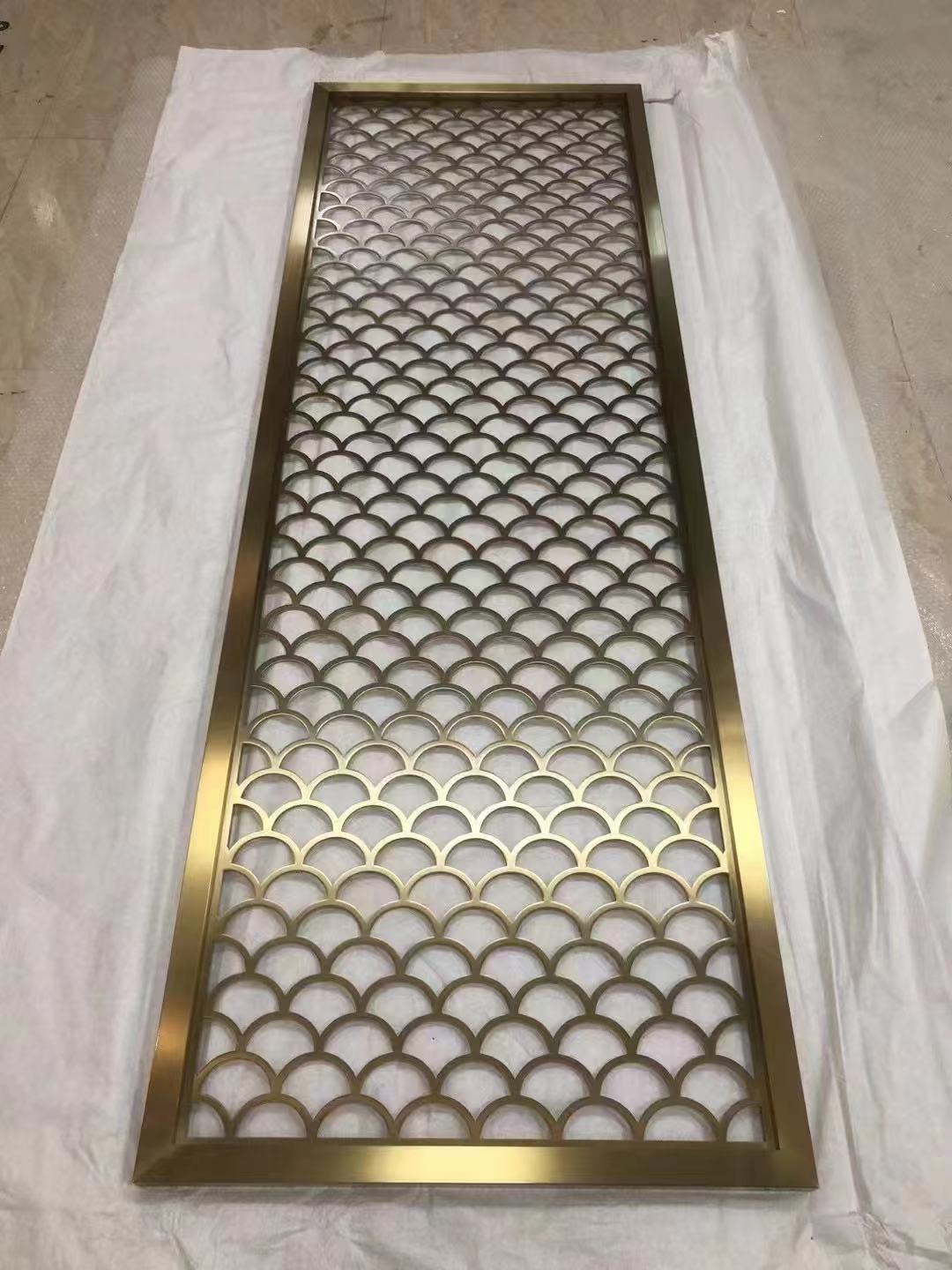
2. Punching. CNC punching and turret punching carry the pattern. This is the fastest route for regular patterns and repeat work, and it produces a consistent hole edge. Hole position tolerance is checked against the drawing at the machine.
3. Laser cutting. Laser cutting handles outlines, cutouts, corner radii, and irregular hole shapes where a punch die is not practical, and it is used for one-off shapes and pattern work that changes across the sheet.
4. Bending and forming. Press brakes form return edges, cassette profiles, and stiffening flanges. Flat panels can distort during bending if the perforation pattern sits on the bend line, so we plan the pattern around the bend allowance at drawing stage rather than correcting it afterward.
5. Welding and assembly. Frames, brackets, and corner joints are welded where the panel design calls for an assembled unit. Welds are dressed and cleaned so the finish reads as continuous across the joint.
6. Surface preparation and coating. Panels are degreased and pretreated, then powder-coated, PVDF-coated, anodized, or mechanically finished according to the approved sample. Coating is applied after all cutting and welding, so the finish covers the finished geometry.
7. Inspection and packing. Before packing we check panel dimensions, hole size and pitch, open area against the approved sample, flatness, burr removal, weld quality, and coating appearance. Inspection records can be provided with the shipment on request.
Each stage is a checkpoint, not a pass-through. If a panel fails a check, it is corrected before it moves on.
Custom Work and Engineering Support
Most of our work is custom perforated panel production, which means the drawing is the starting point rather than a catalog number.
Send a DXF, DWG, PDF, or a physical sample. We will review it and come back with comments on hole size versus thickness, achievable open area, bend and weld positions, and panel size relative to your substrate grid. If you are still developing the design, we can suggest open area values that balance visual density against airflow and light transmission, and we can produce a small sample panel so you can see the pattern at full scale before committing.
Open area is the ratio of total hole area to panel area. It is the number that connects appearance to performance: a higher open area gives more light, more airflow, and more visual transparency, but less stiffness and less screening. For facade and sunshade work, designers often land between 30% and 50%. For ceilings and acoustic backing, the figure is set by the acoustic design. For machine guards and ventilation, it is set by the airflow requirement. We calculate it from the pattern rather than estimating, and we will tell you if your target is not achievable at your chosen hole size and pitch.
Panel size and joint layout also need a decision early. Large facade panels are usually split into modules that follow the mullion grid, with the perforation pattern continuing across the joint. Whether the pattern aligns at the seam depends on the hole pitch dividing evenly into the panel module, so we check this at drawing stage and adjust the panel break if needed.
The approval flow is straightforward: drawing review, sample production, your sign-off on the sample, then batch production against the approved sample. Nothing goes into batch until the sample is confirmed.

Where These Panels Are Used
Building facades and sunshades. Perforated aluminum and stainless panels screen glazing, reduce solar gain, and hide the floor slab edges behind a consistent skin. The pattern can be uniform or graded across the elevation. Panels are typically supplied as cassettes or with a folded return for a concealed fixing.
Ceilings. Perforated panels with a backing layer serve acoustic ceilings in lobbies, transit areas, and open offices. Aluminum is common here for weight; the panel is light enough for standard ceiling grids and accessible for services above.
Interior partitions and screens. Decorative perforated panels separate spaces without blocking light or sightlines completely. Pattern choice does most of the work: a dense small-hole pattern reads as a solid screen at a distance, while a larger open pattern stays visually permeable.
Balustrades and railing infill. Perforated infill panels give a solid-looking guard that still lets air through, which matters on exposed balconies and terraces. Panel edges are folded for stiffness and for fixing to posts.
Signage and decorative elements. Logos, lettering, and graphic patterns cut into sheet, used as signage faces, column cladding, and feature panels.
Ventilation and equipment protection. Perforated guards, grilles, and covers for mechanical plant, cooling equipment, and machinery. Here the open area and hole size are set by airflow and by the size of the object the guard must exclude.
Export and Delivery
We pack for sea freight. Panels are separated with interleaving material, edges are protected, and units are crated or palletized according to size and finish. Coated and anodized surfaces get particular attention at the contact points, since handling damage in transit is the most common cause of a rejected delivery.
We have experience loading full 40HQ containers, and we plan the packing layout around the container dimensions so that panel modules and crates use the space efficiently. For mixed orders, panels, frames, and fixings are packed in sequence so the site can unpack in installation order.
Shipping documents are prepared per order. Depending on what your project or customs process requires, we can provide a packing list, material certificates, and inspection records. Tell us at order stage which documents you need and they will be included.
Lead time is confirmed after the order quantity, material, hole pattern, and finish are settled. We do not quote a delivery date before those variables are fixed.
What to Send for a Quotation
The more of the following you can provide, the faster and more accurate the quote:
Material — stainless 304, 316L, 201, aluminum 1xxx or 5xxx, or galvanized steelSheet thickness — in millimeters
Hole shape and size — round, square, slotted, hex, or custom, with the diameter or dimensions
Open area or pitch — the target percentage, or the hole spacing if you already have a pattern
Panel size and quantity — overall dimensions, and whether the panel is flat or formed
Surface finish — powder coat with color reference, PVDF, anodized, brushed, or mill finish
Drawing or sample — DXF, DWG, PDF, or a physical sample if you have one
Destination port — so we can quote on the correct delivery terms
If some of these are still open, send what you have. We can work through the remaining items with you.
Send Us Your Drawing
If you have a perforated panel requirement, send the drawing or the sample and we will quote against it. Include the material, thickness, hole pattern, panel size, finish, and quantity, and we will come back with a price, a technical review of the drawing, and a sample proposal where a new pattern is involved. Hengai Metal produces custom perforated panels in-house, from a single trial panel to a full container load.
Meta description: Custom perforated metal panels and decorative perforated panels from Hengai Metal, a factory producing punched, cut, bent, and coated panels for facades, ceilings, and screens.